
Shipped Canada-Wide
Know what you’re breathing.
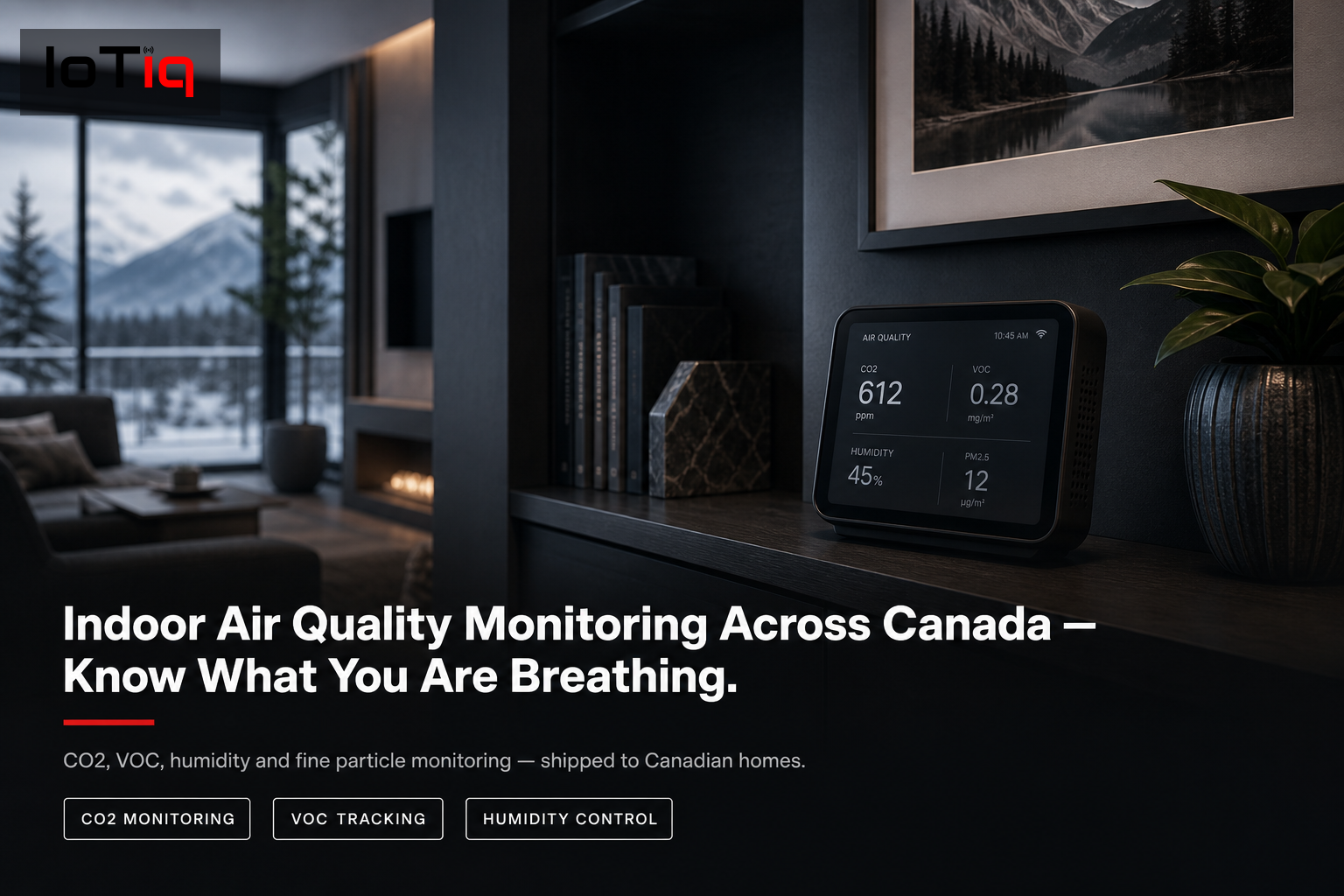
CO2, VOC, humidity and fine particle monitoring, shipped to Canadian homes. When levels reach unhealthy thresholds, ventilation activates automatically. Data stays in your home, not in the cloud.
Get a Free Product ConsultationSee pricing →
✓ Canadian-owned, founded in Halifax
✓ Manufacturer warranty on every product
✓ 30-day free setup support · No obligation to buy
Already own a compatible device? You don’t need to buy it from IoTiq to use it — ordering through us just gets the same hardware pre-configured, bench-tested and backed by 30 days of free setup support at no extra cost. See compatible devices.
800 ppm
Proactive CO2 alert threshold we set
4 signals
CO2, VOC, PM2.5 & humidity tracked
100% local
Data stays in your home
Why It Matters
At 1,000 ppm CO2, you feel it. Most Canadian homes exceed this by noon.
Outdoor air is about 400 ppm. In a sealed Canadian home during winter, CO2 from a few occupants can push past 1,000 ppm within hours. The effects — fatigue, poor focus — are real but easy to misattribute.
CO2 that makes you tired
CO2 rises steadily in occupied, poorly ventilated rooms. At 1,000 ppm you feel fatigued; at 1,500 ppm you can’t concentrate.
VOC from cleaning products & furniture
Volatile organic compounds from paint, furniture and cleaning products accumulate in sealed homes during winter. We track and alert.
PM2.5 from cooking & outdoor pollution
Fine particles from cooking, candles and outdoor pollution are tracked continuously — exposure over time is linked to respiratory issues.
Humidity, too low or too high
Canadian winters cause dry air and static; spring can bring mould risk from high humidity. We monitor both and automate your response.
Automatic ventilation
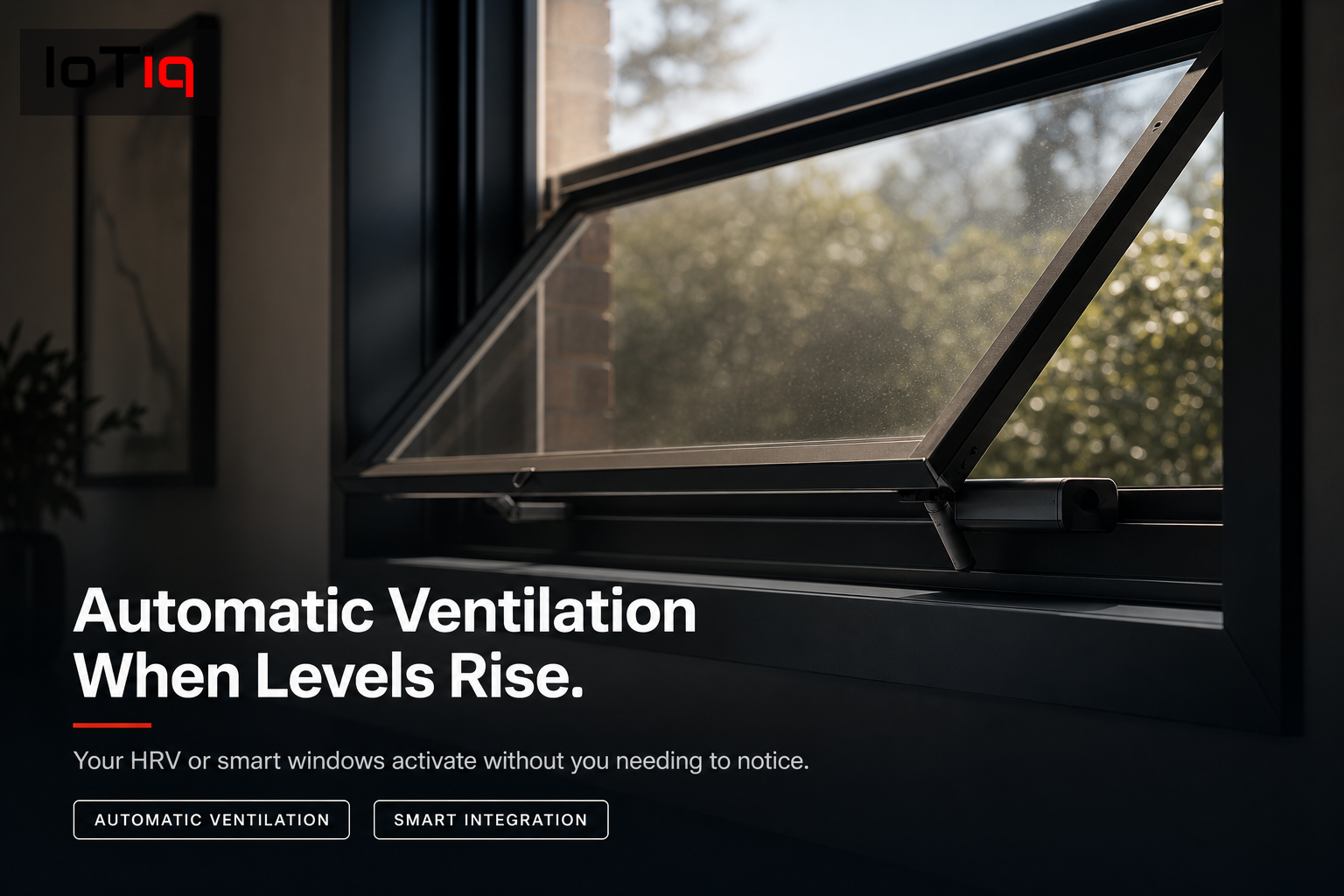
When CO2 or VOC levels exceed safe thresholds, your HRV, ventilation system or smart windows activate automatically.
Weekly air quality reports
Weekly summary of your home’s air quality — peaks, averages and any events where ventilation was triggered.
How It Works
Placed right, integrated,
reporting automatically.
Room selection
We identify which rooms have the highest occupancy and ventilation need — typically bedrooms and living rooms.
Sensor placement
Sensors mounted at breathing height, away from direct sunlight, cooking sources and HVAC vents for accurate readings.
Threshold configuration
Alert thresholds set to established safe limits for CO2, VOC, PM2.5 and humidity, based on Health Canada guidelines.
Ventilation integration
Sensor linked to your HRV, exhaust fan or smart window controller for automatic response.
Dashboard & alerts
Real-time dashboard configured. Phone alerts set for threshold breaches. Weekly email report scheduled.
Baseline establishment
We record your home’s baseline air quality so the first report shows meaningful before/after comparisons.

Pricing
Transparent, from day one.
$400–$700
Integrated with ventilation
$800–$1,400
3-room setup
FAQ
Common questions.
How does winter affect indoor air quality?+−
Canadian homes are sealed for months in winter. Without mechanical ventilation, CO2 accumulates, VOCs concentrate and humidity drops.
What is a safe CO2 level?+−
Outdoor CO2 is about 400 ppm. Health Canada recommends keeping indoor CO2 below 1,000 ppm for comfort. We configure alerts at 800 ppm for proactive action.
Will the sensor trigger my HRV automatically?+−
Yes. We connect the sensor to your HRV or exhaust ventilation system. Ventilation activates automatically when levels exceed your threshold.
Is this suitable for a home with a baby or young children?+−
Particularly so. Children are more sensitive to air quality — CO2 and VOC monitoring in a nursery is one of the most valuable applications we supply.
Does this detect mould?+−
Elevated humidity over time indicates mould risk, and we alert on it. We don’t detect existing mould directly.
How much does air quality monitoring cost in Canada?+−
A single-room monitor integrated with ventilation runs $400–$700. A whole-home 3-room setup runs $800–$1,400.
Is there a subscription?+−
Core monitoring and alerting functions do not require a subscription. All data is stored locally.
Can this be used in a commercial office?+−
Yes. Office air quality monitoring is valuable for employee productivity, and we supply multi-zone commercial systems with reporting.
Keep Going
Explore the rest of Health & Wellness.
Air quality is one piece of a connected health system.