
Shipped Canada-Wide
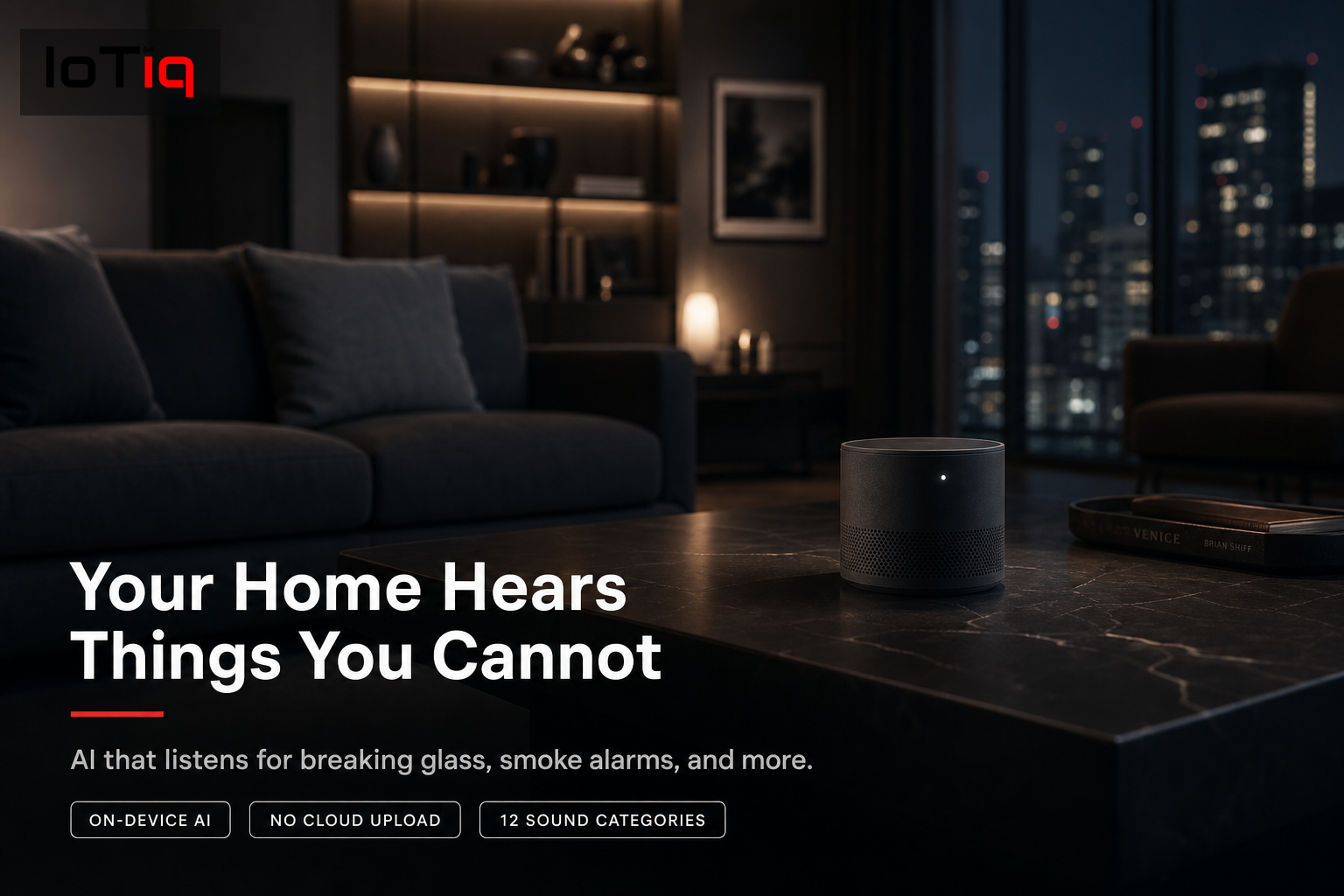
Your home hears things you can’t.
AI that listens for breaking glass, smoke alarms, prolonged coughing and water running — then triggers lights, recording and phone alerts in under three seconds. All processed on-device, nothing uploaded.
Get a Free Product ConsultationSee pricing →
✓ Canadian-owned, founded in Halifax
✓ Manufacturer warranty on every product
✓ 30-day free setup support · No obligation to buy
Already own a compatible device? You don’t need to buy it from IoTiq to use it — ordering through us just gets the same hardware pre-configured, bench-tested and backed by 30 days of free setup support at no extra cost. See compatible devices.
12 sounds
Recognized, each with its own response
< 3 sec
From sound to action
0 audio
Uploaded to the cloud
Why It’s Different
Glass breaks downstairs at 3am. You know in three seconds.
Lights flood the area, recording begins and your phone receives a clip — you see what happened before you’re fully awake. Twelve distinct sound categories, each with its own configured response.
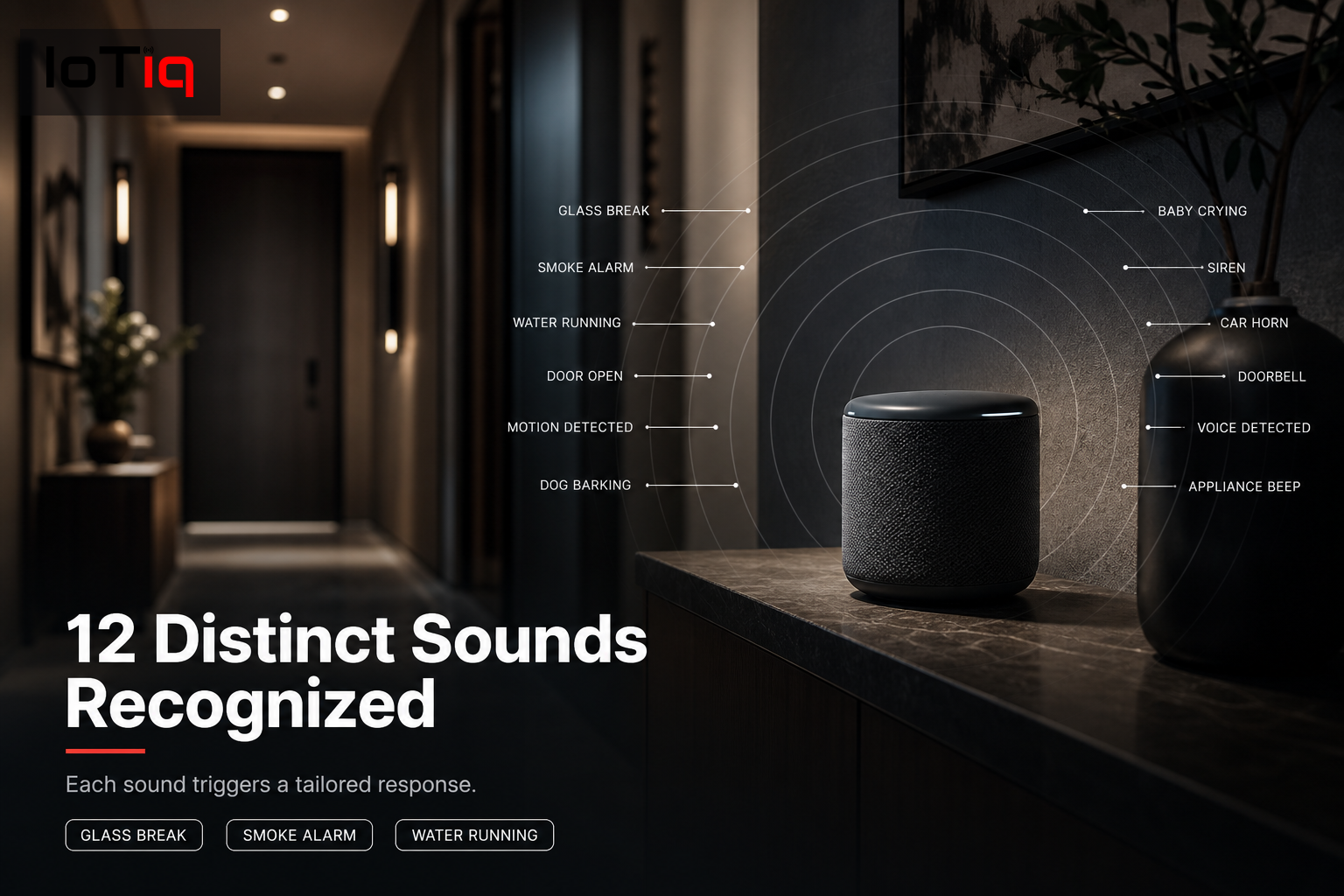
12 distinct sounds recognized
Breaking glass, smoke alarm, CO alarm, baby crying, dog barking, water running, prolonged coughing, car alarm and more.
Different responses for different sounds
Breaking glass triggers security lights and recording. Smoke alarm triggers evacuation notifications. Coughing sends a wellness alert.
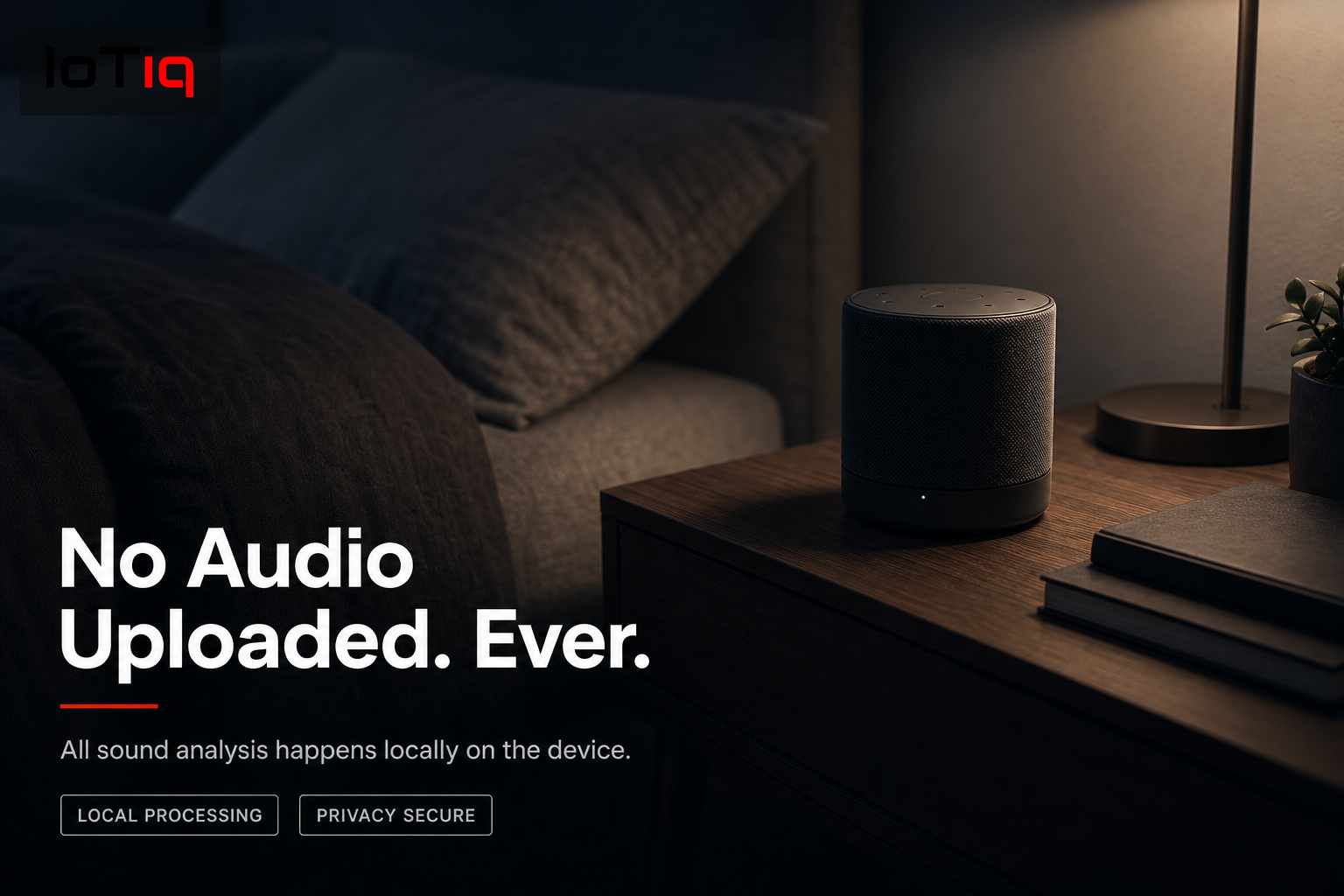
Zero audio uploaded, ever
All audio analysis happens on-device. No clip is ever sent to a cloud server. It detects the event — it doesn’t record conversations.
Homes, offices and rentals
Valuable for residential security, commercial properties after hours and rental units where you need to know something’s wrong without video.
Complements cameras & sensors
Sound recognition catches what cameras miss in the dark or outside their field of view — full coverage, every scenario.
CES 2026 award-winning hardware
Samsung EdgeAware AI Home is our primary platform, recognized for its on-device audio AI capability.
How It Works
Placed correctly,
tested during setup.
Property walk & placement
We identify optimal microphone placement — typically a central ceiling position for maximum coverage.
Sound classification setup
We configure which sounds trigger which responses for your property and household.
Sensitivity calibration
Calibrated for your ambient sound environment — street noise, HVAC, pets — to minimize false triggers.
Response configuration
Lights, recording, alerts and escalation paths set up for each sound category.
Live testing
We test each sound type and confirm the correct response triggers during setup.
30-day tuning
We return at 30 days to adjust sensitivity settings based on real-world performance.
Pricing
Transparent, from day one.
$300–$500
Added to an existing installation
$500–$800
Single property, incl. configuration
FAQ
Common questions.
Does it record my conversations?+−
No. The system detects specific sound events — it does not record, store or transmit audio of any kind. It listens for patterns, not content.
Will street noise cause false alerts?+−
We calibrate the system for your specific ambient sound environment. Traffic, wind and normal household noise are filtered out during calibration.
Can it distinguish my smoke alarm from a TV showing one?+−
Yes. The system is trained on real smoke alarm acoustics. A TV broadcast is spectrally different from a physical alarm in the same room.
Does it work when I’m home?+−
Yes, around the clock regardless of occupancy. You can suppress specific alerts, like dog barking notifications, when you’re home through the app.
What happens at night when the house is quiet?+−
Sensitivity is automatically higher when ambient sound levels drop, so even subtle sounds are detected more reliably.
How much does sound recognition setup cost?+−
Added to an existing installation, $300–$500. As a standalone installation, $500–$800 including configuration and testing.
Does it replace a traditional alarm system?+−
It complements rather than replaces. Traditional alarms protect specific entry points; sound recognition covers the full interior acoustic space.
Is there an ongoing subscription?+−
Core sound recognition functionality does not require a subscription. An optional support plan is available for ongoing help if you want it.
Keep Going
Explore the rest of Security.
Sound recognition is one piece of a connected security system.