Licence Plate Recognition Systems: How AI Automates Access Control, Parking and Logistics

A gate guard costs a salary. A plate reader costs a camera. That comparison is why licence plate recognition is usually the first piece of AI vision a business deploys — the workflow it replaces is manual, repetitive, and easy to measure: someone writes down a plate, checks a list, and opens a barrier.
What Is Licence Plate Recognition?
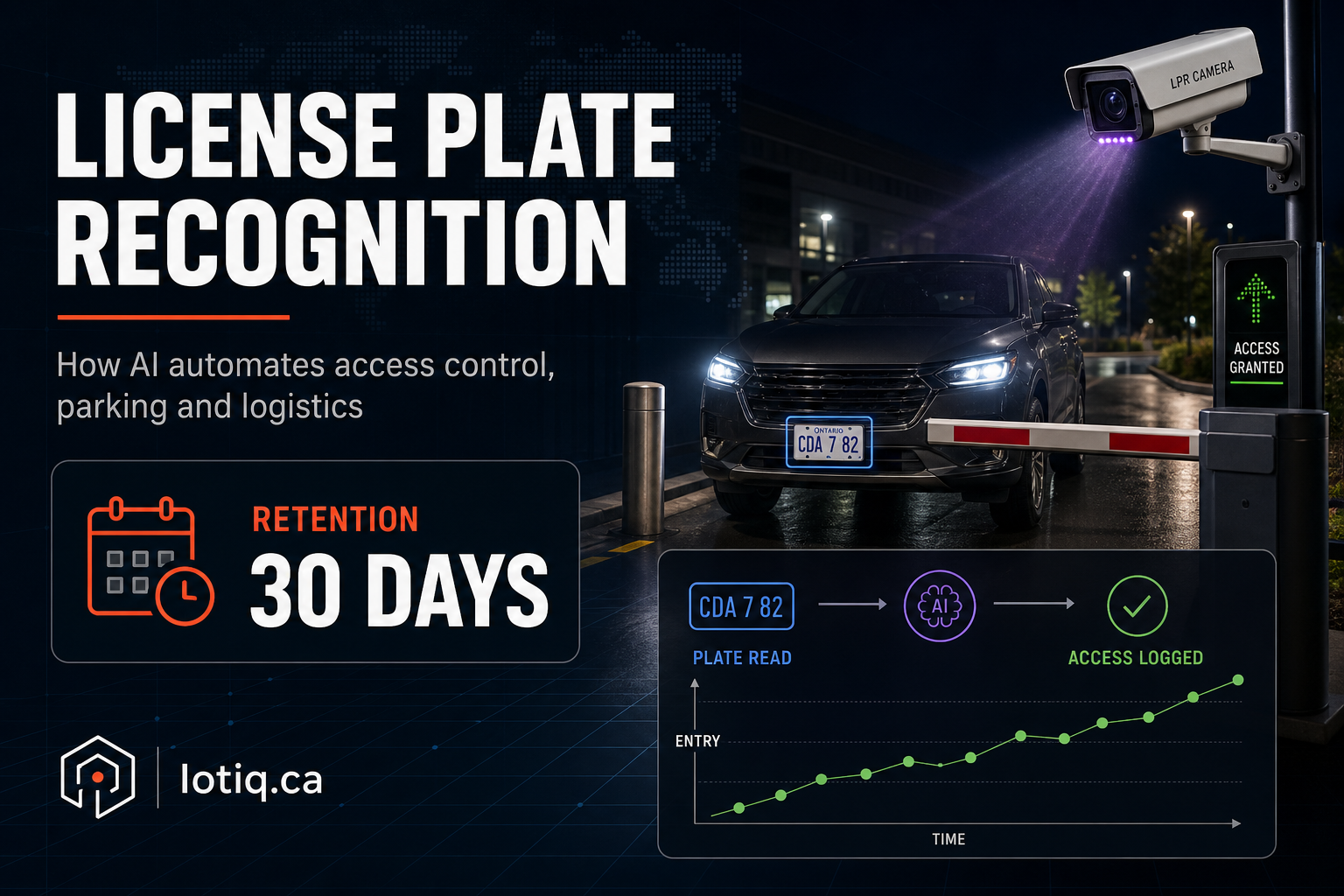
Licence plate recognition (LPR, also called ANPR — automatic number plate recognition) is a computer vision pipeline that finds a vehicle’s plate in a camera frame, reads the characters on it, and outputs the plate as text with a timestamp. That string is then checked against a list — authorized, banned, expected delivery, paid parking session — and something happens: a gate opens, a log entry is written, a ticket is closed, an alert fires.
The important framing for a business decision-maker: LPR does not “recognize vehicles.” It reads a licence plate. Make, colour and model detection are separate capabilities, and matching a plate to a person is a legal question rather than a technical one.
How It Actually Works: Four Steps
- Detection. An object detection model locates the plate region within the frame — this has to work at speed, at an angle, and in the dark.
- Normalization. The plate crop is deskewed, contrast-corrected and rescaled so the characters are readable by the next stage.
- Character recognition (OCR). A recognition model converts the image into characters. Modern systems read the whole plate as a sequence rather than segmenting each character, which handles smudges and partial occlusion better.
- Validation. The raw string is checked against the expected plate format for the jurisdiction, and against previous frames of the same vehicle. Reading a plate five times as it approaches and taking the consensus is what pushes a good system’s real-world accuracy well above what any single frame delivers.
That fourth step is the one buyers skip when comparing vendors, and it is where most of the practical accuracy actually lives.
Where LPR Pays for Itself
| Environment | What LPR replaces | Measurable result |
|---|---|---|
| Gated communities and condo garages | Fobs, clickers, visitor phone calls | Residents enter without stopping; visitor access is time-limited and logged |
| Paid and tenant parking | Manual enforcement patrols | Overstays and unauthorized vehicles flagged automatically |
| Logistics yards and docks | Guard-booth paperwork at check-in | Arrival and departure timestamps per truck; dwell time becomes measurable |
| Factories and industrial sites | Manual gate operation | Contractor vehicles admitted only during their scheduled window |
| Dealerships and outdoor yards | After-hours patrols | Any plate entering outside business hours triggers an alert |
Yard dwell time deserves a specific mention. Once every truck has an entry and exit timestamp, “how long do carriers wait at our site” stops being an argument and becomes a number — which is usually the first thing a logistics operation discovers it can actually improve.
The Accuracy Problems Nobody Mentions in the Demo
Vendor accuracy figures are measured on clean footage. Sites are not clean. The realistic failure modes:
- Headlight bloom and darkness. The single biggest cause of night-time misreads. The fix is infrared illumination plus a short shutter speed, not a higher-resolution sensor.
- Snow, road salt and mud. A Canadian winter reality: a plate can be genuinely unreadable to a human, and no model reads what is not there. Systems handling this well fall back to partial-match logic and vehicle-arrival events rather than failing silently.
- Angle and speed. Plates read best close to head-on. A camera mounted high and off to the side to “cover more” reads worse than a lower camera aimed at the lane.
- Character confusion. 0/O, 8/B, 1/I and 5/S are the classic pairs. Jurisdiction-specific format validation resolves most of these, which is why a system configured for Nova Scotia plates outperforms a generic one.
- Plate frames and tinted covers. Dealer frames that overlap characters cause persistent misreads for that specific vehicle — usually solved by whitelisting the known-good read.
Practical guidance: specify one camera per lane, aimed at the lane, mounted between roughly 0.9 and 1.5 metres above plate height at a shallow angle, with dedicated IR. Placement fixes more accuracy problems than any software setting.
Where the Privacy Line Sits in Canada
A licence plate that can be linked to an identifiable individual is personal information under Canadian privacy law. That does not make LPR unusable — it makes the design decisions matter. Collect for a stated purpose (access control, parking enforcement, site security), post notice, and set a retention period that matches the purpose rather than keeping every read indefinitely. A gated-community system that keeps 30 days of entry logs is defensible; one that silently builds a multi-year movement history of every resident is a different proposition entirely.
This is also why plate reading and facial recognition should not be discussed as if they were the same tier of technology. A plate is registered to a vehicle; a face is a biometric. The obligations, and the public tolerance, are not comparable.
Integrating LPR With What You Already Run
LPR’s value multiplies when the plate event triggers something. The integrations that matter in practice:
- Barrier and gate controllers — an authorized plate opens the barrier with no fob and no call.
- Access control systems — the vehicle event and the door event land in one log, so “the truck arrived at 06:12 and the driver badged into the warehouse at 06:19” is one timeline.
- Alerting — an unknown plate after hours notifies the on-call person with the still image attached, which is what makes a night alert actionable rather than annoying.
- Dashboards and reporting — occupancy by hour, average dwell time per carrier, peak arrival windows.
IoTiq builds LPR into the same operational layer as cameras, sensors and access control, so a plate read is a workflow trigger rather than an isolated log in a standalone appliance. For outdoor sites and vehicle-heavy businesses, the outdoor and auto business package pairs plate reading with weatherproof cameras and dusk-to-dawn lighting; condo and site management provisions resident garage access automatically. Access on the human side stays card- and code-based, deliberately without facial recognition.
Quick Answers
What is licence plate recognition? LPR (or ANPR) is computer vision that locates a vehicle’s plate in a camera image, reads its characters as text, and matches the result against a list — authorized, banned, expected, or paid — to trigger an action such as opening a gate or writing a log entry.
How accurate is LPR in real conditions? Accuracy depends far more on camera placement, lighting and jurisdiction-specific format validation than on the model itself. A well-placed dedicated lane camera with infrared illumination and multi-frame consensus reading performs dramatically better than a general-purpose overview camera, which frequently misreads at night or at an angle.
Does LPR work in snow? It works well until the plate itself is physically obscured by snow, salt or mud, at which point no system can read it. Well-designed deployments handle this by treating an unreadable plate as a vehicle-arrival event requiring manual handling, rather than failing silently.
Related Guides
Scoping It for Your Site
If vehicles entering and leaving your site are currently logged on paper — or not at all — plate recognition is usually the fastest measurable win available. Book a free assessment and we will scope it against your gate, lighting and lane layout.