AI for Workplace Safety: Detecting Helmets, Vests and PPE Violations in Real Time

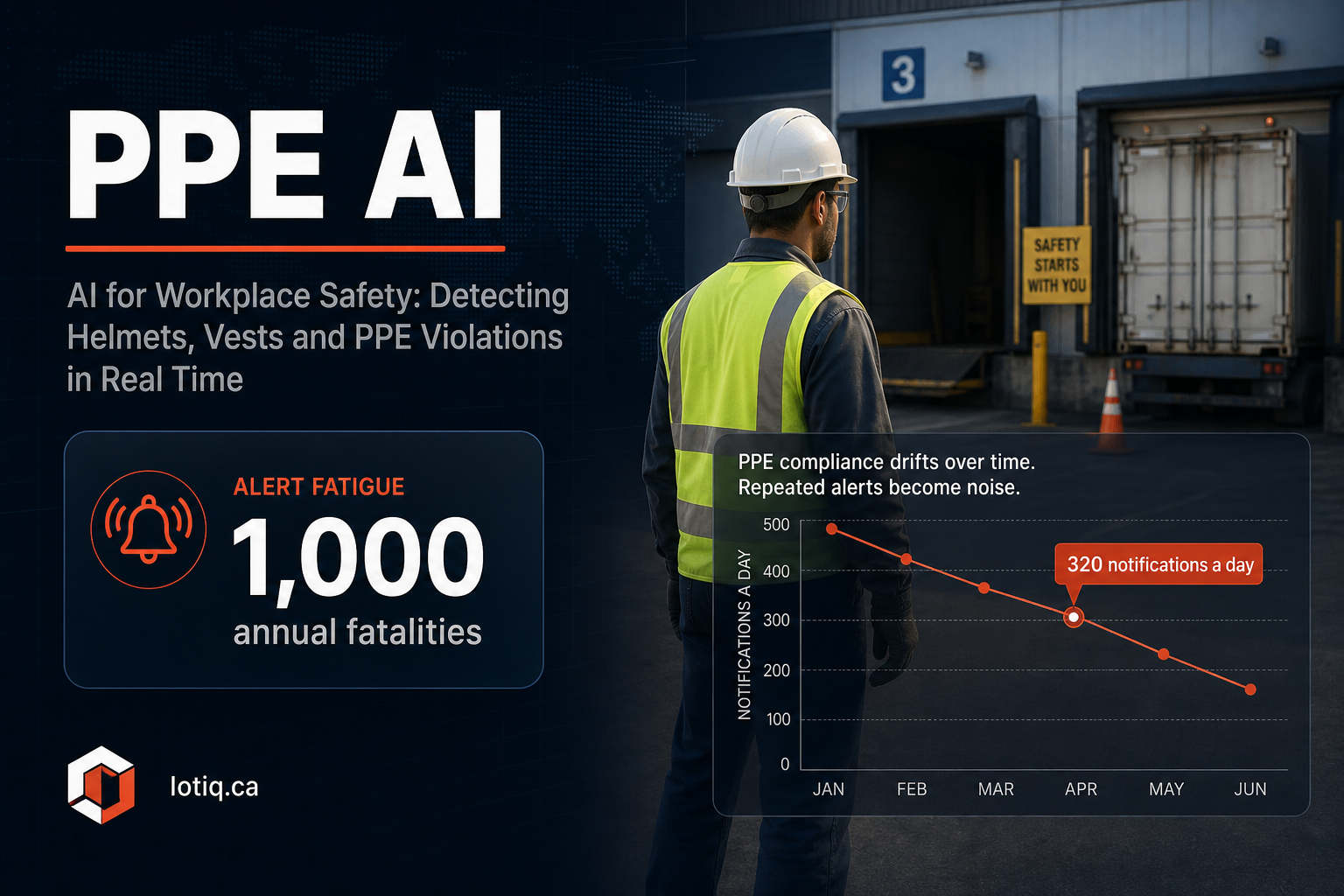
Every safety manager knows the pattern. PPE compliance is near-perfect during an audit week and drifts the moment attention moves elsewhere. AI detection changes what is possible here, but only if the alert design is right. The problem was never that people do not know the rule — it is that nobody is watching the loading bay at 4:40 p.m. on a Friday, and the consequences of the gap only become visible after an incident.
Why PPE Compliance Drifts
Personal protective equipment is the last line of defence in the hierarchy of controls — it sits below elimination, substitution, engineering controls and administrative controls precisely because it depends entirely on a person putting it on, every time, correctly. CCOHS is explicit that PPE should never be the sole control measure, and the reason is behavioural: compliance decays under time pressure, in short “I’m only going in for a second” trips, and in transitional areas where the rule boundary is not physically obvious.
In Canada, workplace injuries accepted for compensation run to hundreds of thousands of lost-time claims and roughly a thousand fatalities a year across all industries, according to national workers’ compensation statistics. A meaningful share of head, eye and high-visibility incidents involve equipment that was available but not worn at that moment.
How AI PPE Detection Works
A computer vision model runs on the camera stream and performs two linked tasks: detect each person in the frame, then classify whether the expected protective equipment is present on that person. In practice this means a detection model finds people, hard hats, hi-vis vests, and — where the camera resolution supports it — gloves, safety glasses and hearing protection, and an association step decides which equipment belongs to which person.
The system then applies your rules, not generic ones. A zone-based configuration is what makes this usable:
- Zones: hard hat required in the production floor polygon, hi-vis required across the entire yard, no requirement in the office corridor the camera also sees.
- Time windows: rules that apply during operating shifts and relax during cleaning hours.
- Dwell thresholds: flag only after a person has been in the zone non-compliant for, say, 10 seconds — which eliminates the enormous volume of alerts generated by someone briefly crossing a corner of the frame.
What It Detects Reliably — And What It Does Not
| Detection | Practical reliability | Main limiting factor |
|---|---|---|
| Hi-vis vest present | High | Colour under sodium or low light; unzipped vests at odd angles |
| Hard hat worn | High | Distinguishing a hat carried or hung on a hook from one worn |
| Person in restricted zone | High | Zone boundary calibration to the actual floor plane |
| Safety glasses | Moderate | Small object; needs close, well-lit camera positions |
| Gloves | Moderate to low | Hands are frequently occluded by the work being done |
| Correct chin strap use, hat condition, fit | Not detectable | Requires physical inspection |
The honest summary: AI detects presence, not adequacy. It can tell you nobody entered the press area without a hard hat this month. It cannot tell you the hat is undamaged, in date, or correctly adjusted. Those remain human inspection tasks, and any vendor implying otherwise is overselling.
The Alert Design Problem
This is where most PPE deployments succeed or fail, and it is arithmetic rather than technology. Consider ten cameras covering active zones. If each produces even two questionable detections an hour across a 16-hour operating day, that is 320 notifications a day. No supervisor reads 320 notifications. Within a week the channel is muted, and the system now provides documented evidence of violations that nobody acted on — arguably a worse position than having no system.
Designs that survive contact with a real site share the same characteristics:
- Dwell thresholds before alerting — non-compliance must persist for a set number of seconds.
- Escalation instead of broadcast — a local visual or audible cue at the zone first, supervisor notification only on repeat or persistence.
- Daily digests for trends, real-time alerts only for high-severity zones — most PPE data is a trend signal, not an emergency.
- An agreed alert budget — decide what a tolerable number of alerts per shift looks like before installation, then tune to it.
Where the Real Value Shows Up
Ironically, the strongest business case is usually not catching individuals. It is the aggregate view: which zone, which shift and which task consistently produce non-compliance. That data turns a behavioural argument into an engineering one — if the hard hat rate collapses at the same doorway every afternoon, the answer is usually signage, a storage rack at the entrance, or a changed walking route, not disciplinary action.
Secondary value comes from documentation. Timestamped compliance records support due-diligence obligations under provincial occupational health and safety legislation and give insurers and auditors something more substantive than a signed policy binder.
Industries Where It Fits Best
- Construction: hard hat and hi-vis at site entry points, plus contractor access control; particularly valuable on sites with no permanent power or network, where solar and 4G-connected camera units apply.
- Manufacturing: zone-specific rules around presses, cutting and chemical handling areas.
- Warehousing and logistics: hi-vis in forklift lanes and loading docks, where the PPE rule and the traffic risk are the same problem.
- Energy and utilities: restricted-zone entry combined with equipment checks at substations and plant perimeters.
Doing This Without Turning It Into Surveillance
PPE monitoring is monitoring of employees, and Canadian privacy expectations apply. Three design choices keep it proportionate: detect anonymous people rather than identifying individuals, notify the zone rather than naming a person where the goal is correction rather than discipline, and be transparent with the workforce about what is detected and what is retained. Systems introduced as a safety tool with visible rules tend to be accepted; systems discovered by employees tend to be resisted regardless of their technical merit.
IoTiq deploys PPE detection as part of the same platform that handles access, sensors and automation, so a violation event can trigger a local light or announcement, log the occurrence, and roll into a weekly compliance report — without facial recognition and with processing kept local by default. See the construction site package for solar and 4G-connected deployments, or warehouse and logistics for indoor zone monitoring.
Quick Answers
Can AI cameras detect if someone is not wearing a hard hat? Yes. Hard hat and hi-vis vest detection are among the most reliable PPE detections, typically applied per zone with a dwell threshold so brief passes through the frame do not generate alerts. Smaller items such as safety glasses and gloves are considerably less reliable and depend on close, well-lit camera positions.
Does PPE detection replace safety supervision? No. It detects whether equipment is present, not whether it is in good condition, correctly fitted or in date, and PPE itself is the lowest tier in the hierarchy of controls. It works as continuous coverage between inspections and as a source of compliance trend data, not as a replacement for supervision.
How do you stop PPE alerts from becoming noise? Use dwell thresholds before an event counts, escalate locally before notifying supervisors, send trends as daily digests and reserve real-time alerts for high-severity zones, and agree on an acceptable alerts-per-shift target during commissioning.
Related Guides
Getting Started
If your PPE compliance is currently measured by spot checks, the first useful step is defining zones and rules against your actual floor plan. Book a free assessment to scope it.