Drowning Detection with AI: How Computer Vision Can Improve Pool and Facility Safety

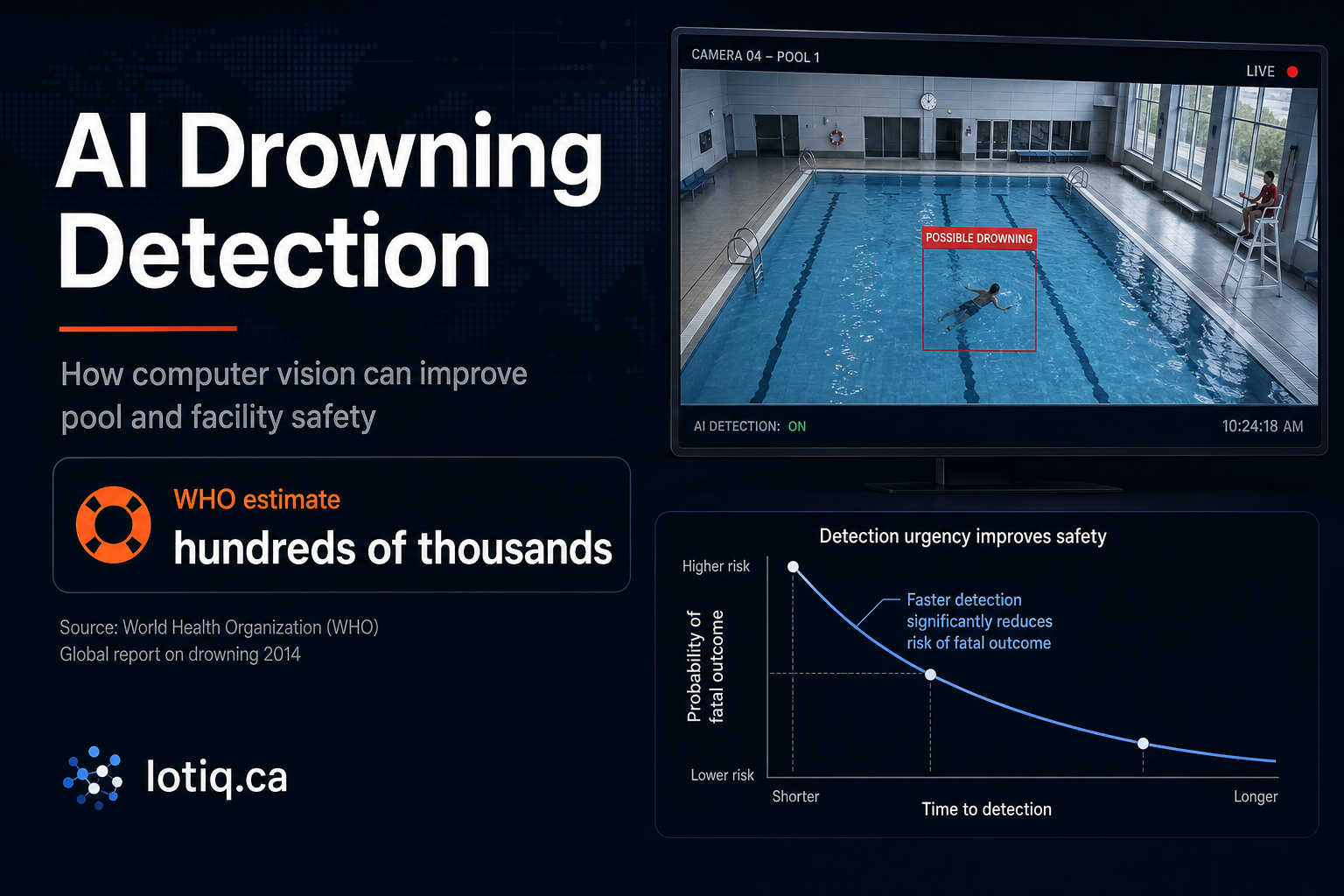
The most persistent myth about drowning is that it looks like the movies — splashing, shouting, waving. It usually does not. Drowning is typically quiet and fast, which is precisely why it can happen in a supervised pool with people nearby. The World Health Organization estimates drowning claims hundreds of thousands of lives worldwide each year, and a substantial share occur in supervised settings rather than remote ones.
Why Supervision Alone Has Limits
A lifeguard’s job is a sustained visual search task across a moving, refracting, glare-affected surface, with a required scan cycle across an entire zone, for hours. The known constraints are structural rather than personal:
- Scan cycle time. Standard practice requires scanning an assigned zone within a set interval. Anything happening between scans of a given area is, by definition, unobserved for that interval.
- Surface glare and refraction. A submerged body is visually distorted and can be nearly invisible from certain angles depending on lighting and water movement.
- Crowd occlusion. Busy sessions are exactly when supervision is hardest and risk is highest.
- Vigilance decay. Sustained attention on rare events degrades over a shift — a well-documented human factors limitation, not a training failure.
The response window is short. Time to irreversible harm in a submersion incident is measured in a few minutes, which makes detection latency the variable with the most leverage over outcome.
How AI Drowning Detection Works
Systems in this category typically use underwater cameras, above-water cameras, or both, and track each swimmer’s movement pattern rather than looking for a single “drowning pose.” The signals that matter:
- Sustained submersion beyond a threshold. A body remaining below the surface for longer than a configured interval in a zone where that is not expected — the most reliable and most common trigger.
- Loss of forward motion while submerged. Swimmers move; a distressed or unconscious body drifts or sinks.
- Vertical position with minimal progress — the near-vertical, low-movement posture associated with distress, sometimes preceding submersion.
- Body at the pool floor with no movement, which underwater camera systems detect directly.
When the pattern is confirmed, the system alerts staff — typically to a poolside display or a wearable device carried by lifeguards — with the location in the pool indicated, so the response is directed rather than a search.
The Honest Limitations
This is a life safety context, so the constraints deserve more prominence than the capabilities:
- It is a second layer, never a replacement for supervision. No credible system, and no responsible vendor, positions AI detection as a reason to reduce lifeguard staffing. It exists to shorten the interval between an incident and someone noticing it.
- Water conditions constrain detection. Cloudy water, heavy surface turbulence, strong glare and inadequate lighting all degrade performance materially.
- Camera coverage defines detection. Underwater camera systems require enough units to cover the pool volume without blind spots — deep ends, corners and areas under diving boards are the typical gaps.
- Detection is not rescue. The system shortens notification time. Everything after that — reaching the swimmer, extraction, resuscitation — depends entirely on trained staff being present and ready.
- False alarms have a specific cost here. A system that alerts too often trains staff to hesitate, which is worse than no system. Threshold configuration in a life safety context is a serious engineering exercise, not a preference setting.
Where It Fits
- Hotel and condominium pools — frequently unsupervised or intermittently supervised, which is where a detection layer changes the most.
- Municipal and community aquatic centres — high bather loads and complex pool geometry.
- Sports and training facilities — long sessions with attention focused on coaching rather than surveillance.
- Schools and campus pools — variable supervision ratios across different user groups.
- Waterparks — high visual complexity and crowding, where the practical value is highest and the technical difficulty is also highest.
Camera Placement and Practical Design
Detection quality in an aquatic environment is determined more by installation than by software:
- Underwater cameras give the most reliable submersion detection, because they are not fighting surface glare and refraction. They also require pool-wall installation, which is far easier during construction or renovation than as a retrofit.
- Above-water cameras are simpler to install and useful for surface distress patterns and general supervision, but degrade with glare, reflections and crowd occlusion.
- Lighting matters as much as the cameras. Consistent underwater lighting removes a large share of detection errors.
- The alert has to reach a person who is already in position. A poolside display or a staff wearable is effective; an email or a notification on a phone in an office is not.
Privacy and Ethics in a Sensitive Setting
Pools involve people in swimwear, frequently including children, which places these deployments at the sensitive end of video monitoring. Defensible practice: process locally and do not stream pool video off site; retain only the short clip surrounding a detection event rather than a continuous archive; restrict live view to designated staff positions; never apply facial recognition or any identification capability; and post clear notice at entrances that safety monitoring is in use. The purpose is detecting a body in distress — a purpose that requires no identification whatsoever, and a system designed accordingly is both more defensible and easier to explain to users of the facility.
Quick Answers
How does AI drowning detection work? Cameras above and often below the waterline track each swimmer’s movement, and the system flags patterns associated with distress — most reliably sustained submersion beyond a set threshold combined with loss of movement. Confirmed events alert staff at poolside or on a wearable with the location in the pool indicated.
Can AI replace lifeguards? No, and no responsible deployment is positioned that way. Detection shortens the time between an incident and someone noticing it. Rescue, extraction and resuscitation depend entirely on trained staff being present, so the technology is a second layer over supervision rather than a substitute for it.
What makes drowning detection unreliable? Cloudy water, heavy surface turbulence, strong glare, inadequate underwater lighting, and camera coverage that leaves blind spots in deep ends or corners. Coverage design and pool lighting affect real-world performance more than the choice of algorithm.
Related Guides
Reviewing Your Facility
For hotels, condominium buildings and facilities with pools that are not continuously supervised, the practical question is how long an incident could go unnoticed at the quietest hour. Book a free assessment to review coverage and alerting.