How AI Video Analytics Turns Existing CCTV Into Real-Time Business Intelligence

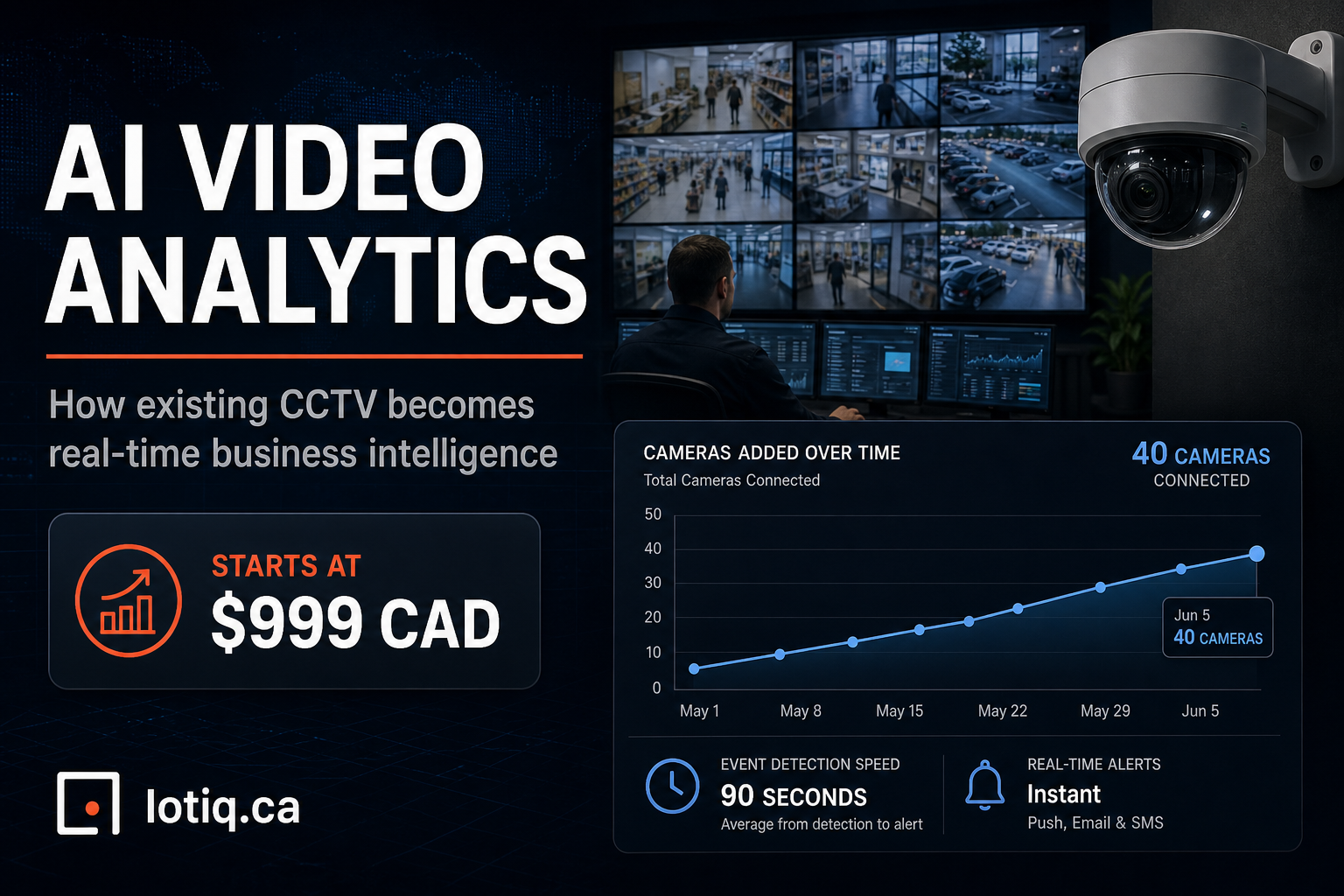
Most commercial buildings already have cameras. What they usually do not have is anyone watching them. A recorded feed answers questions after the fact — who was in the loading bay at 2:14 a.m., which aisle the spill happened in — but it does not act, alert, or count. That gap between recorded and understood is the entire business case for AI video analytics.
What Is AI Video Analytics?
AI video analytics is software that interprets a live camera stream in real time and turns what it sees into structured events: a person entered a restricted zone, a vehicle stopped for longer than 90 seconds, a forklift and a pedestrian occupied the same lane, a door was propped open. Instead of storing pixels for later review, the system classifies what is happening frame by frame and emits an event that other systems can act on — an alert, a log entry, a light, a lock, a dashboard counter.
The technical shift is straightforward: a computer vision model (typically an object detection network) runs on the video stream and reports what it detects and where. The operational shift is bigger — surveillance stops being a passive archive and becomes a sensor that produces data.
Why Traditional CCTV Stops Being Enough
The limitation of conventional CCTV is not image quality. It is attention. Research on human monitoring performance has long shown that sustained vigilance on rare events degrades quickly — an operator watching a wall of screens for hours misses far more than most people assume, and the more cameras per operator, the worse it gets. A 40-camera site cannot be meaningfully “watched” by one person, and a 4-camera site rarely justifies paying someone to watch it at all.
So the realistic status quo in most businesses is this: cameras record continuously, nobody watches them live, and footage is pulled only after something has already gone wrong. That is a forensic tool, not a preventive one. It has value — but it costs the same whether it prevents anything or not.
Real-Time Alerts vs. Passive Recording
| Passive recording | AI video analytics | |
|---|---|---|
| When you find out | After the incident, if someone reviews footage | While it is happening |
| Labour required | Manual review, often hours per incident | Review only flagged clips |
| Output | Video files | Video files plus timestamped, countable events |
| Can trigger other systems | No | Yes — lights, locks, sirens, tickets, dashboards |
| Value when nothing goes wrong | Near zero | Operational data: traffic, dwell time, utilization |
That last row is the one most businesses underestimate. A camera that also counts customers per hour, measures how long trucks wait at a dock, or reports which entrance is actually used produces value on days when there is no security incident at all.
Where It Actually Earns Its Keep
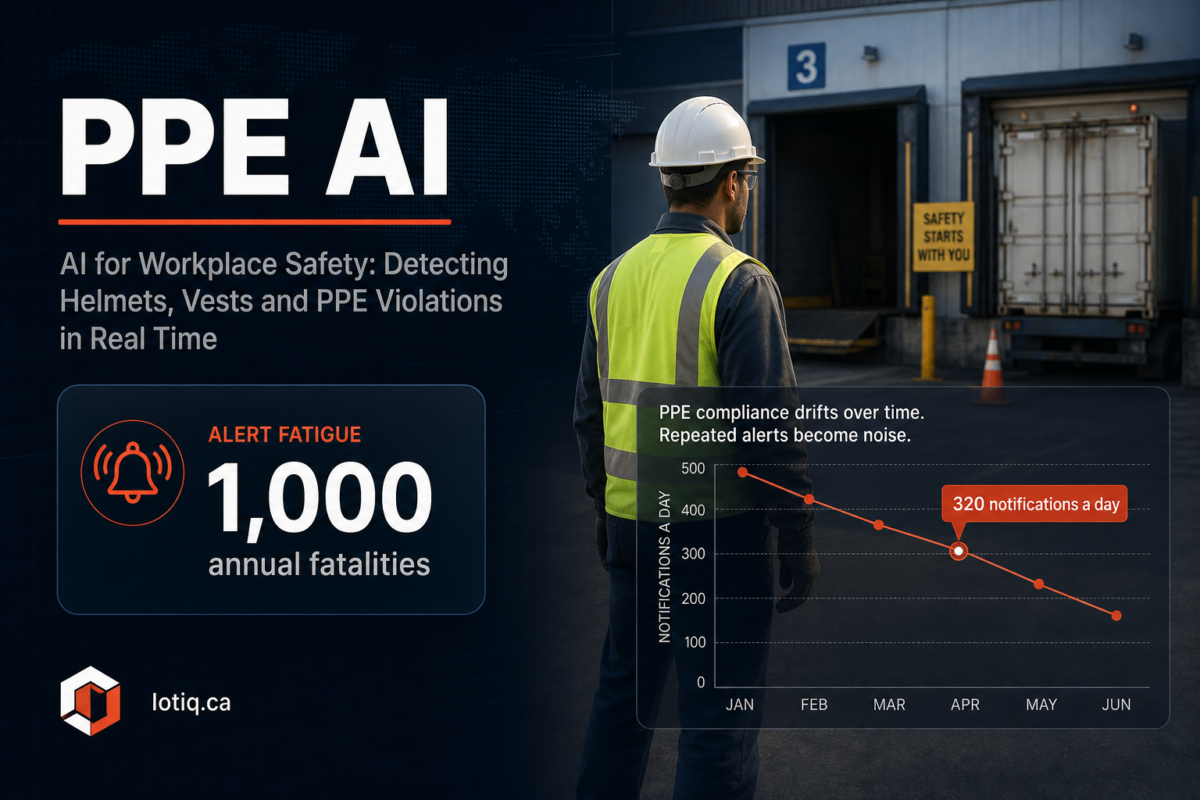
- Manufacturing and warehousing: pedestrian-in-forklift-lane detection, restricted-zone entry, PPE compliance, blocked fire exits, dock and loading-bay dwell time.
- Retail: hourly footfall, queue length at checkout, entrance-versus-aisle traffic, after-hours motion at high-shrink areas.
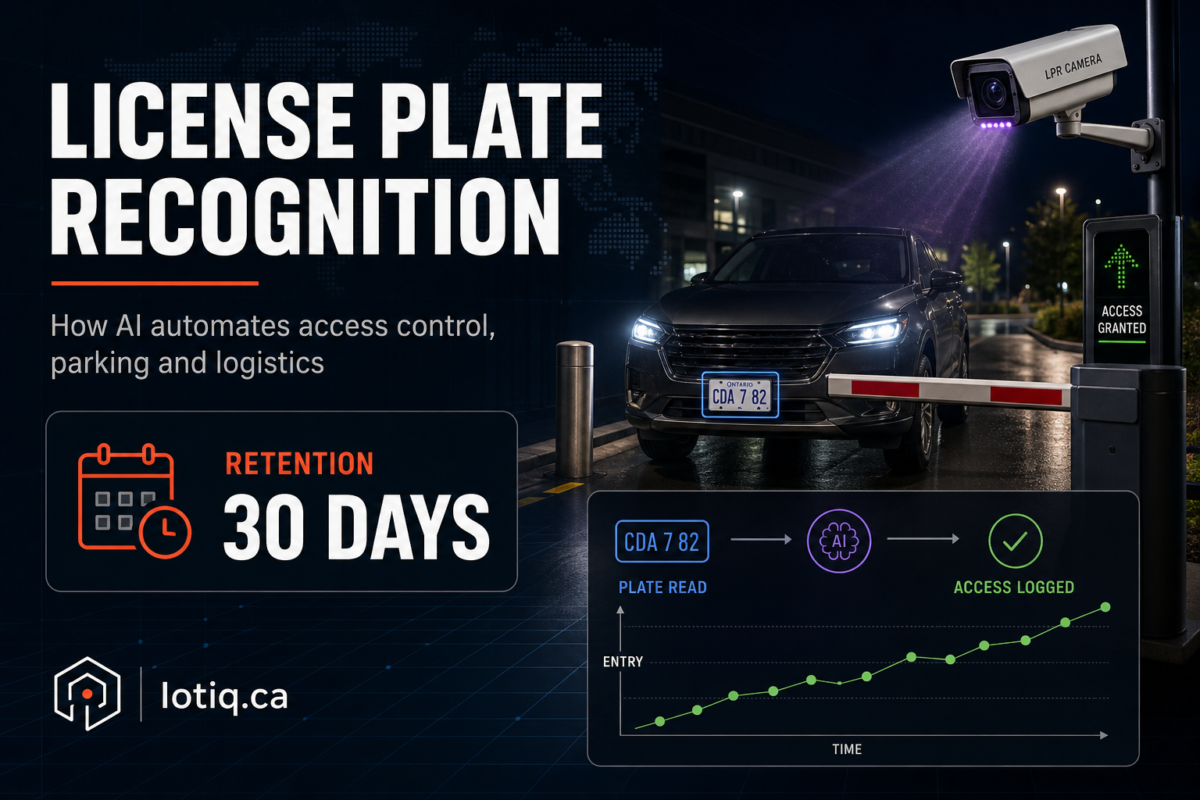
- Parking and vehicle yards: licence plate reading for entry and exit, occupancy counts by zone, vehicles parked where they should not be.
- Multi-site property and facilities: perimeter intrusion after hours, doors propped open, common-area occupancy across a portfolio on one screen.
- Public and shared spaces: crowd density thresholds, loitering in stairwells, unattended-object dwell time.
What This Does Not Solve
Being direct about the limits matters more than the marketing does:
- Camera placement beats model quality. A model cannot detect what the lens does not see. Bad angles, backlit doorways, and 8-metre mounting heights degrade accuracy far more than the choice of algorithm.
- Every deployment needs a tuning period. The first week produces too many alerts. Thresholds, zones, and schedules have to be adjusted against your actual site before the alert stream becomes trustworthy.
- False positives have a real cost. Twenty cameras with even a small per-hour false-alarm rate can generate dozens of notifications a day. An alert stream people stop reading is worse than no alerts, because it creates the appearance of coverage.
- Detection is not identification. Detecting “a person” is a different capability from recognizing which person, and the second one carries legal obligations the first one does not.
The Privacy Question Canadian Businesses Have to Answer First
In Canada, video that captures identifiable individuals is personal information. Under PIPEDA, private-sector organizations need a demonstrable purpose for collecting it, must limit collection to what that purpose requires, and must inform people that surveillance is taking place. The Office of the Privacy Commissioner’s guidance for overt video surveillance is explicit that cameras should be a proportionate response to a real, identified problem — not a default installation.
Two practical consequences follow. First, a system that counts anonymous objects (“3 people in this zone”) sits in a very different risk category than one that identifies individuals biometrically — which is why many operators deliberately avoid facial recognition. Second, where the processing happens matters: analytics that run locally on site, sending events rather than continuous video to the cloud, materially reduce the amount of personal information leaving the building.
How IoTiq Approaches It
IoTiq’s commercial deployments are built around connecting cameras, sensors, access control and automation into a single operational layer rather than selling a camera and leaving the interpretation to whoever is on shift. Practically, that means the detection event is the beginning of a workflow — a restricted-zone entry can turn on a light, notify a supervisor, and write a timestamped log line in the same second — and that portfolio operators see every location on one dashboard instead of one login per site. Access control is provisioned per user with card or code entry, deliberately without facial recognition. IoTiq Commercial packages start at $999 CAD and are scoped by facility rather than sold as a fixed bundle.
How to Evaluate a Deployment Before You Buy One
- Name the event, not the technology. “We need to know when the fire exit is blocked” is a specification. “We need AI cameras” is not.
- Decide who receives the alert and what they will do within 60 seconds of receiving it. If there is no answer, the alert has no value.
- Agree on an acceptable false-alarm rate per day before installation, and treat the first two weeks as tuning, not failure.
- Ask where inference runs — on site or in the cloud — and what leaves the building.
- Ask what the system produces on quiet days. Counts, dwell times and utilization data are what make the investment pay back when nothing goes wrong.
Quick Answers
What is AI video analytics? Software that interprets a live camera feed in real time and converts what it sees into structured, timestamped events — a person in a restricted zone, a vehicle overstaying, a blocked exit — that can trigger alerts or automations instead of only being recorded.
Can AI analytics be added to existing cameras? Often yes. Analytics can run on a server or edge device that consumes the existing camera streams, so usable IP cameras can frequently be retained. Cameras with poor placement, low resolution or heavy backlighting typically need to be repositioned or replaced regardless of the software.
Is AI video surveillance legal in Canada? Overt video surveillance is generally permitted for private-sector organizations under PIPEDA when there is a legitimate, identified purpose, collection is limited to that purpose, and people are notified. Biometric identification such as facial recognition carries significantly higher obligations, and Quebec imposes additional requirements on biometric systems.
Talk to IoTiq
If you already have cameras and want them to produce alerts and operational data instead of archives, the useful first step is scoping which events actually matter at your site. Book a free assessment or see how the platform is packaged for warehouses, retail and multi-property portfolios.