
Indoor Air Quality Monitoring: Why Sealed Canadian Homes Make It Worth It

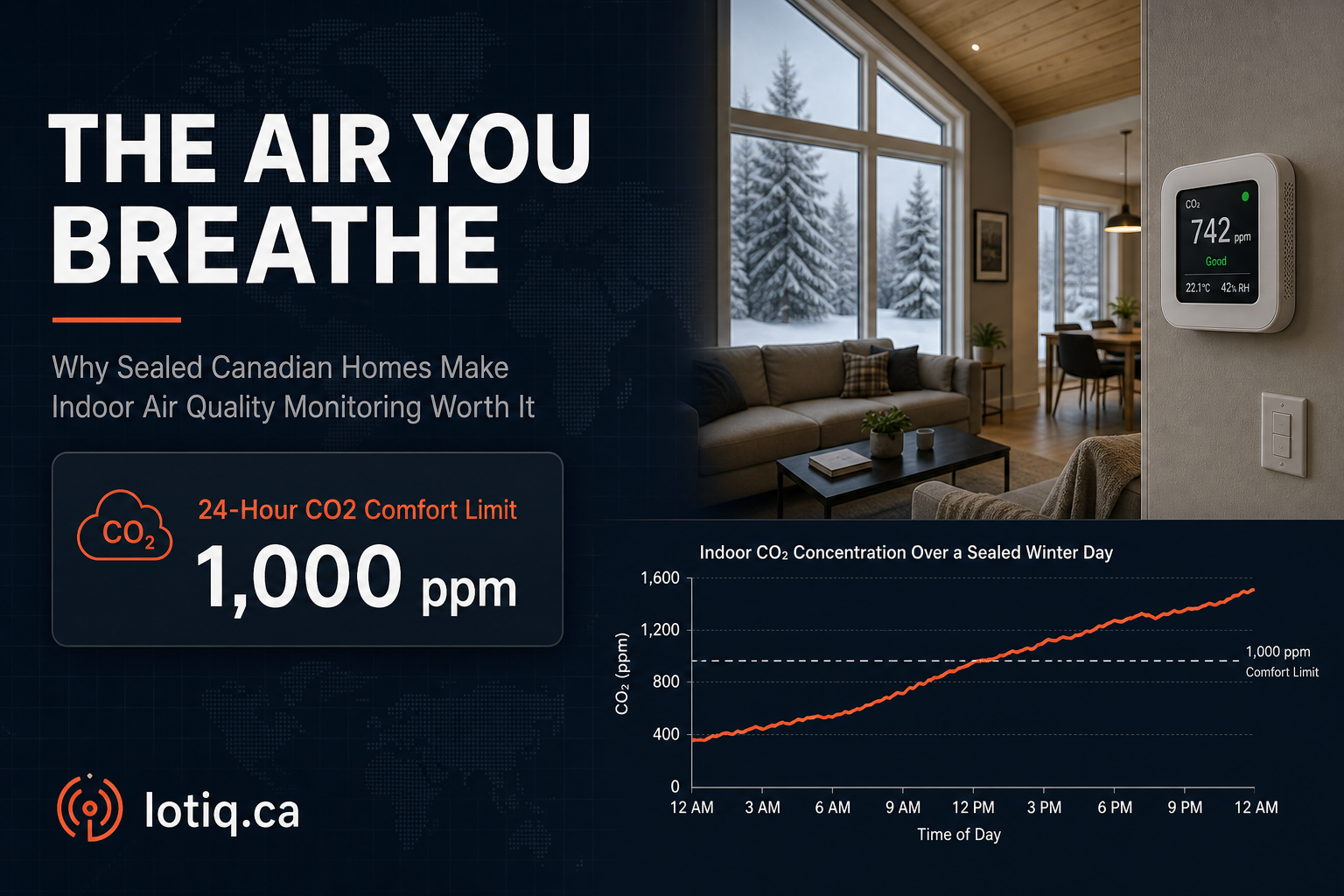
Outdoor air runs around 400 parts per million (ppm) of CO2. Seal a few people into a well-insulated Canadian home for a winter afternoon with the windows shut, and that number can climb past 1,000 ppm before anyone notices anything beyond “I feel a bit foggy today.” That fog has a measurable cause, and it’s one of the more overlooked side effects of exactly the kind of energy-efficient, well-sealed home construction that’s otherwise a good thing.
The Number Worth Knowing: 1,000 ppm
Health Canada’s residential indoor air quality guideline sets 1,000 ppm as the 24-hour average threshold for CO2 — not a toxicity limit (serious health effects aren’t expected until well above that), but a comfort-and-performance guideline based on real evidence of symptoms below it: fatigue, headache, and measurably reduced concentration and decision-making performance. This isn’t a hypothetical number; a household without mechanical ventilation running through a sealed winter day can genuinely cross this threshold within hours of everyone being home, and the tiredness that follows is easy to misattribute to a long day rather than the air itself.
Why Sealed, Efficient Homes Make This Worse, Not Better
This is the counterintuitive part: the same building improvements that make a Canadian home cheaper to heat — better insulation, tighter window seals, draft-proofing — also reduce the natural air exchange that used to happen accidentally through gaps and leaks. A drafty older home effectively ventilates itself, badly and expensively. A modern, well-sealed home holds heat efficiently and holds stale air just as efficiently, unless mechanical ventilation (an HRV or exhaust fan system) is doing the job the drafts used to do by accident.
The Four Things Actually Worth Tracking
| Pollutant | Main source | Why it matters |
|---|---|---|
| CO2 | Occupant breathing, accumulating in poorly ventilated rooms | Directly tied to fatigue and reduced concentration at elevated levels |
| VOCs (volatile organic compounds) | Paint, new furniture, cleaning products | Accumulate in sealed homes, particularly noticeable in winter when ventilation is minimized to conserve heat |
| PM2.5 (fine particulates) | Cooking, candles, and outdoor pollution infiltrating the home | Linked to respiratory issues with sustained exposure over time |
| Humidity | Varies seasonally — often too low in winter, too high in spring | Low humidity causes dry air and static; sustained high humidity raises mould risk |
What Monitoring Actually Changes
A sensor by itself doesn’t fix anything — its value is in triggering a response before the problem is bad enough to notice on its own. A well-integrated setup connects directly to an HRV, exhaust fan, or smart window controller, so ventilation activates automatically once CO2 or VOC levels cross a configured threshold, rather than depending on someone remembering to crack a window. Some setups configure a proactive alert threshold below the Health Canada comfort guideline itself — around 800 ppm, for instance — specifically to trigger ventilation before levels reach the point where occupants are already feeling the effects, rather than reacting after the fact.
Why This Matters More for Some Rooms Than Others
Bedrooms and nurseries are disproportionately valuable places to monitor, for a simple reason: they’re occupied continuously for 7–9 hours with the door often closed and ventilation frequently minimized overnight to conserve heat — exactly the conditions that let CO2 and VOCs accumulate the most. This is particularly relevant for infants and young children, who are more sensitive to air quality generally, making a nursery one of the highest-value single-room placements for a monitor rather than an afterthought.
What Monitoring Doesn’t Do
Worth being direct about a limitation: elevated humidity over time indicates mould risk, not confirmed mould — a sensor tracks the conditions that allow mould to develop, but doesn’t detect existing mould growth directly. If humidity readings suggest a persistent problem, that’s a signal to investigate further, not a diagnosis on its own.
Where the Data Goes
Consistent with a local-first approach to home sensing generally, air quality data is meaningfully more useful — and more private — when it stays on your own network rather than requiring a cloud round-trip to check a live reading or generate a weekly summary report. A baseline reading in the first week or two also matters more than people expect: it’s what turns a raw number into a meaningful “better or worse than normal for this specific home” comparison, rather than an isolated data point with no context.
Getting Started
A single-room monitor integrated with existing ventilation typically runs $400–$700; a whole-home 3-room setup runs $800–$1,400. See the air quality monitoring page for current pricing and ventilation integration options.
Quick Answers
What CO2 level is considered a problem indoors? Health Canada’s residential guideline sets 1,000 ppm as the 24-hour average comfort threshold. It’s not a toxicity limit, but levels above it are linked to fatigue and reduced concentration.
Can an air quality sensor detect mould? Not directly. Elevated humidity over time indicates mould risk, which the sensor tracks, but it doesn’t detect existing mould growth itself.
