
Circadian & Motion Lighting 101: The Science of Light That Adjusts to Your Day

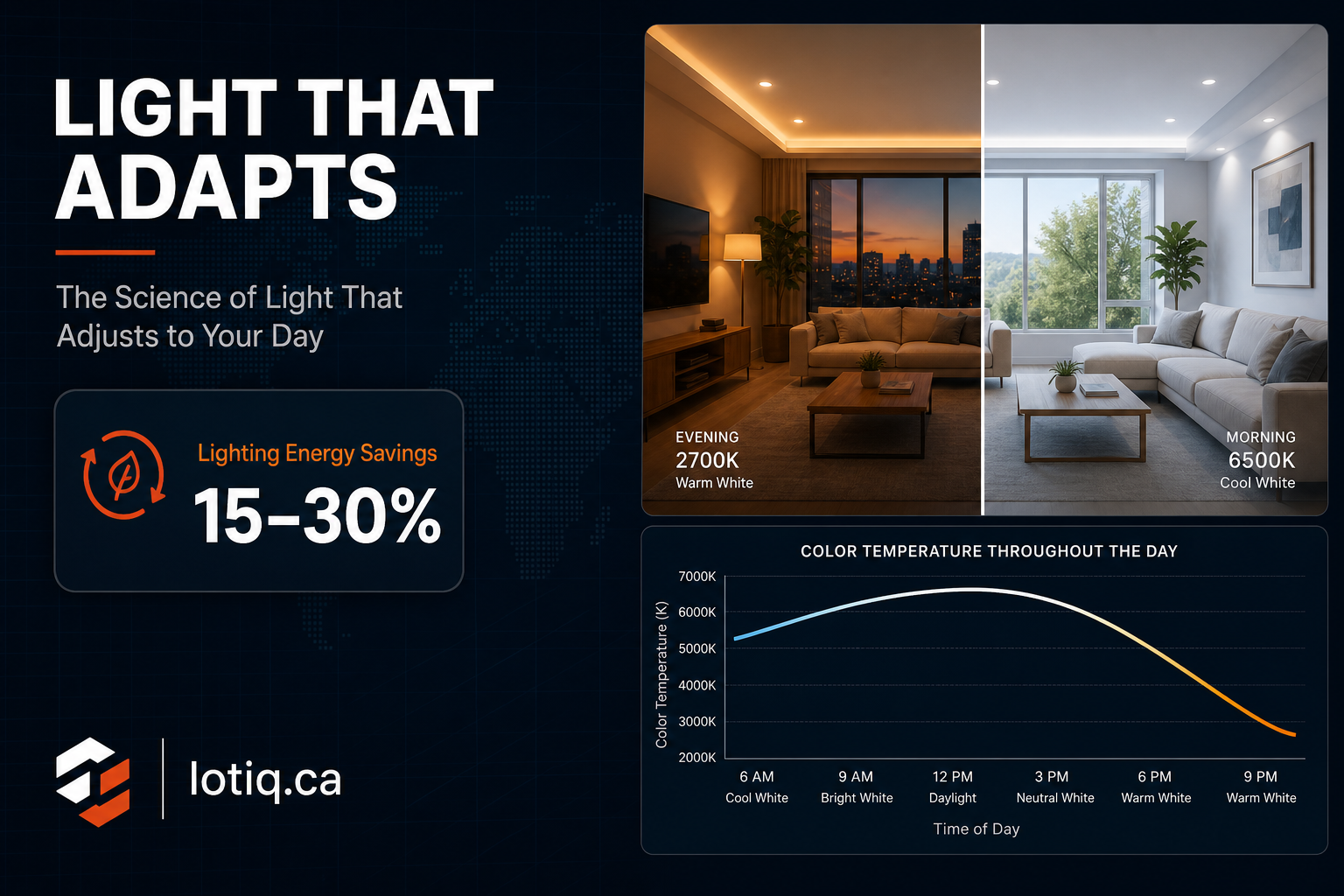
Two very different lighting technologies both get marketed as “smart lighting,” and they solve completely different problems. Circadian lighting is about the colour and timing of light across your day. Motion lighting is about whether a light turns on and off without you touching a switch. Understanding both — and where one common motion-sensing technology quietly fails — is worth the five minutes it takes to read this.
Circadian Lighting: The Science, Briefly
Your body’s internal clock takes cues from light — specifically, the colour temperature and intensity of the light you’re exposed to at different times of day. Cool, blue-shifted light (measured around 6500K) signals daytime alertness; warm, amber-shifted light (around 2700K) signals evening wind-down. This isn’t a wellness marketing claim — it’s a well-established finding in sleep and circadian research: blue-enriched light in the evening suppresses melatonin production and delays the onset of sleep, while warmer light in the hours before bed doesn’t have the same effect.
Circadian lighting automates this shift across the day — cool white light in the morning, gradually warming through the afternoon and evening, tracking your actual local sunrise and sunset times rather than a fixed clock schedule (which matters because sunrise and sunset shift by hours across the year). Most households report a noticeable difference in sleep quality within about two weeks of consistent use — not because the light is doing something exotic, but because it’s finally giving your body clock consistent, correctly-timed cues instead of the same bright white light regardless of the hour.
Why This Matters More in a Canadian Winter
Daylight hours shrink dramatically across Canada in winter — some cities see under nine hours of daylight by January — which means the average person is getting a fraction of the natural light exposure their circadian system evolved to expect. Without deliberate light cues, this commonly shows up as sluggish mornings and difficulty winding down at a reasonable hour, since indoor lighting left on a single fixed colour temperature doesn’t reinforce the day/night distinction the way it would during a Canadian summer’s long daylight hours. This is the single biggest reason circadian lighting delivers a more noticeable effect here than in climates with more consistent year-round daylight.
Motion Lighting: Where Most Systems Quietly Fail
Standard motion sensors use PIR (passive infrared) technology, which detects movement — meaning a room with someone sitting still, reading, or working at a desk for more than a few minutes will often have its lights shut off automatically, because as far as a PIR sensor is concerned, stillness looks identical to an empty room. This is the most common complaint about motion-activated lighting, and it’s a real limitation of the sensor type, not a configuration mistake.
mmWave radar-based presence detection solves this specific problem: rather than detecting gross movement, it detects the micro-movement of breathing, which means a room with a person in it — sitting still, sleeping, working quietly — reads as occupied continuously, and lights only turn off once the room is genuinely empty. This is the same radar sensing category used in fall-detection systems, applied here to a much lower-stakes but very practical problem: not sitting in the dark because you stopped moving for four minutes.
Where Each Sensor Type Actually Makes Sense
| Location | Recommended sensor | Why |
|---|---|---|
| Hallways, closets, stairwells | PIR | Brief transit spaces — no risk of someone sitting still long enough to trigger a false “empty” reading, and PIR is the lower-cost option |
| Living rooms, home offices, bedrooms | mmWave | Occupied for extended stillness (reading, working, sleeping) — PIR would falsely register these rooms as empty |
| Bathrooms | mmWave, with dimmed night settings | Stillness during use, plus the ability to trigger dim warm light instead of full brightness for overnight visits |
| Garages and exterior entries | PIR or mmWave depending on dwell time | Quick transit usually suits PIR; longer dwell time (working in a garage) suits mmWave |
The Practical Payoff
Beyond convenience, motion-activated lighting that reliably turns off empty rooms — rather than being left on out of habit — measurably reduces lighting energy use, typically in the 15–30% range for a household that adopts it across multiple rooms. Combined with circadian lighting’s gradual dimming and warming in the evening, the two systems complement each other well: one manages when lights are on at all, the other manages what colour and brightness they are while they’re on.
Getting Started
Circadian lighting typically starts around $400–$900 for a two-room setup (bedroom plus living room), scaling to $1,200–$2,500 for whole-home coverage. Motion lighting runs $150–$350 per room for a straightforward addition to existing fixtures. See circadian lighting and motion lighting for current pricing and room-by-room configuration options.
Quick Answers
Why do PIR motion lights turn off while I’m still in the room? Standard PIR sensors detect movement, not presence. Sit still for a few minutes and the sensor reads the room as empty, even though someone’s there.
How soon does circadian lighting actually improve sleep? Most households report a noticeable difference within about two weeks of consistent use, once the body clock adjusts to correctly-timed light cues.
