
AI Sound Recognition: Catching Smoke Alarms, Breaking Glass and Running Water That Cameras Miss

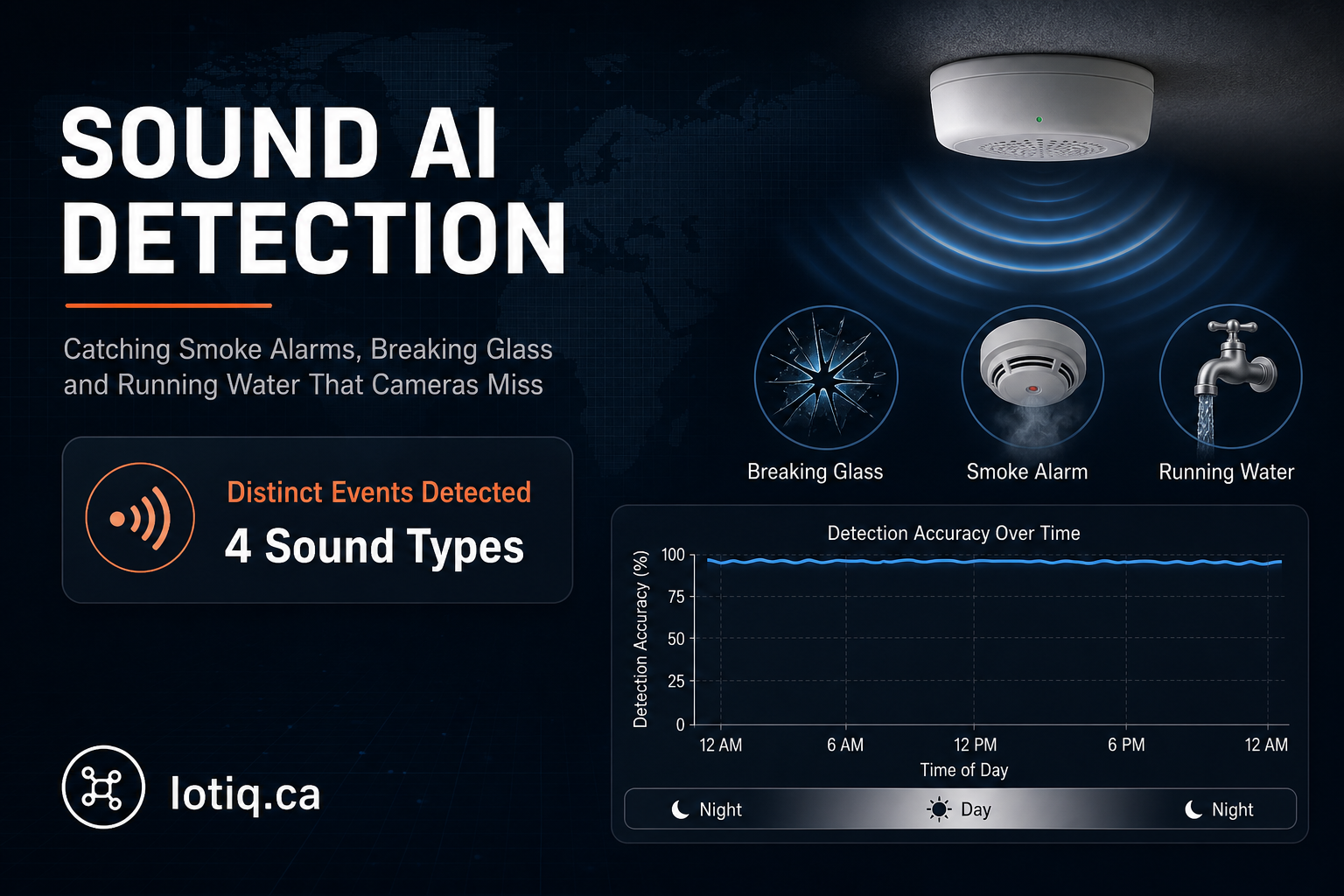
Cameras see what’s in their field of view, in the light, when nothing’s blocking the lens. A huge amount of what actually goes wrong in a home happens outside all three of those conditions — glass breaking in a dark basement, a smoke alarm going off in a room with no camera, a tap left running out of sight. Acoustic sound recognition covers exactly that gap, and it’s a more mature technology than most people realize.
How It Actually Works
Rather than recording and storing audio, a sound recognition system is trained to identify the acoustic signature of specific events — the sharp, distinctive frequency pattern of glass breaking is very different from a dropped plate; a smoke alarm’s pattern is different from a smartphone playing a video of one; running water has its own consistent acoustic profile. The system listens continuously but only acts when it matches a trained pattern against one of its recognized categories — it’s detecting an event, not transcribing or storing conversation.
This is a meaningful technical distinction worth understanding before you decide whether a system like this feels invasive: it’s the difference between a smoke detector that “hears” and a recording device. A well-built system processes audio on-device and uploads nothing — not the ambient sound, not a clip, nothing — to any cloud server. What leaves the device is an event notification (“smoke alarm detected, kitchen, 2:14am”), not audio.
What It Catches That Cameras and Sensors Don’t
| Sound category | What it actually catches | Why a camera or standard sensor might miss it |
|---|---|---|
| Breaking glass | Forced entry via a window, even in a room with no camera | Cameras only cover their field of view; most homes don’t have one in every room |
| Smoke / CO alarm | An existing (non-smart) alarm going off anywhere in the home | A standalone smoke detector alerts locally but doesn’t notify you remotely on its own |
| Water running | A tap or appliance left on, or running somewhere it shouldn’t be | Not visible unless a camera happens to be pointed at that exact fixture |
| Prolonged coughing | A wellness signal that may indicate a health change, especially for an elderly household member | Easy to miss if you’re not in the room; not something a motion sensor detects at all |
The pattern across all four: sound doesn’t require line of sight, doesn’t require light, and doesn’t require the event to happen where a lens is pointed. That’s the core case for treating acoustic detection as a distinct layer, not a redundant one.
The Legitimate Privacy Question, Answered Directly
“Is this just a hidden microphone” is the right question to ask, and it deserves a direct answer rather than a marketing dodge. A properly built sound-event system is trained to recognize acoustic patterns, not to transcribe speech or store audio — technically, it can’t produce a recording of a conversation because it isn’t designed to retain raw audio at all, only to output a match against a small number of trained event categories. If a product you’re evaluating can’t clearly explain what data, if any, is stored or transmitted, that’s a legitimate reason to look elsewhere — the whole value proposition depends on that boundary being real, not just claimed.
Why Multiple Sounds Get Different Responses
Treating every detected sound identically would make the system either too aggressive (waking the whole house for a barking dog) or too passive (treating a smoke alarm like background noise). A well-configured setup assigns a distinct response per category: breaking glass triggers security lighting and event recording from any connected cameras; a smoke or CO alarm triggers an evacuation-style notification, escalated differently than a routine alert; prolonged coughing sends a quieter wellness notification rather than an urgent one. This kind of response mapping is configured during setup, based on the household’s actual layout and priorities, not left at a generic default.
What Reduces False Alerts
The most common practical objection to sound-based detection is false triggers from ordinary household or street noise — and the honest answer is that calibration matters more than the underlying sensor quality. A system calibrated to a specific property’s ambient sound profile (traffic, HVAC noise, pets) filters out that baseline and only flags genuine deviations, and most systems automatically increase sensitivity overnight when the ambient noise floor naturally drops, since a subtle sound at 3am is more likely to be meaningful than the same sound at 3pm.
Where It Fits in a Broader System
Sound recognition is explicitly a complement, not a replacement, for cameras, door/window sensors, and a monitored alarm panel if you have one — it covers the acoustic gap those other layers leave, particularly in the dark, out of camera view, or in a room with no dedicated sensor. See the smart sound alarm page for current pricing as a standalone install or an add-on to an existing security setup.
Quick Answers
Does sound recognition record my conversations? No. It’s trained to recognize acoustic patterns like breaking glass or a smoke alarm, not to transcribe or store audio — it can’t produce a recording of a conversation because it isn’t built to retain raw audio at all.
Can it tell my smoke alarm apart from a TV showing one? Yes. A physical alarm and a TV broadcast of one have different acoustic signatures, and a properly trained system distinguishes between them.
