
Does a Smart Security System Actually Lower Your Home Insurance in Canada?

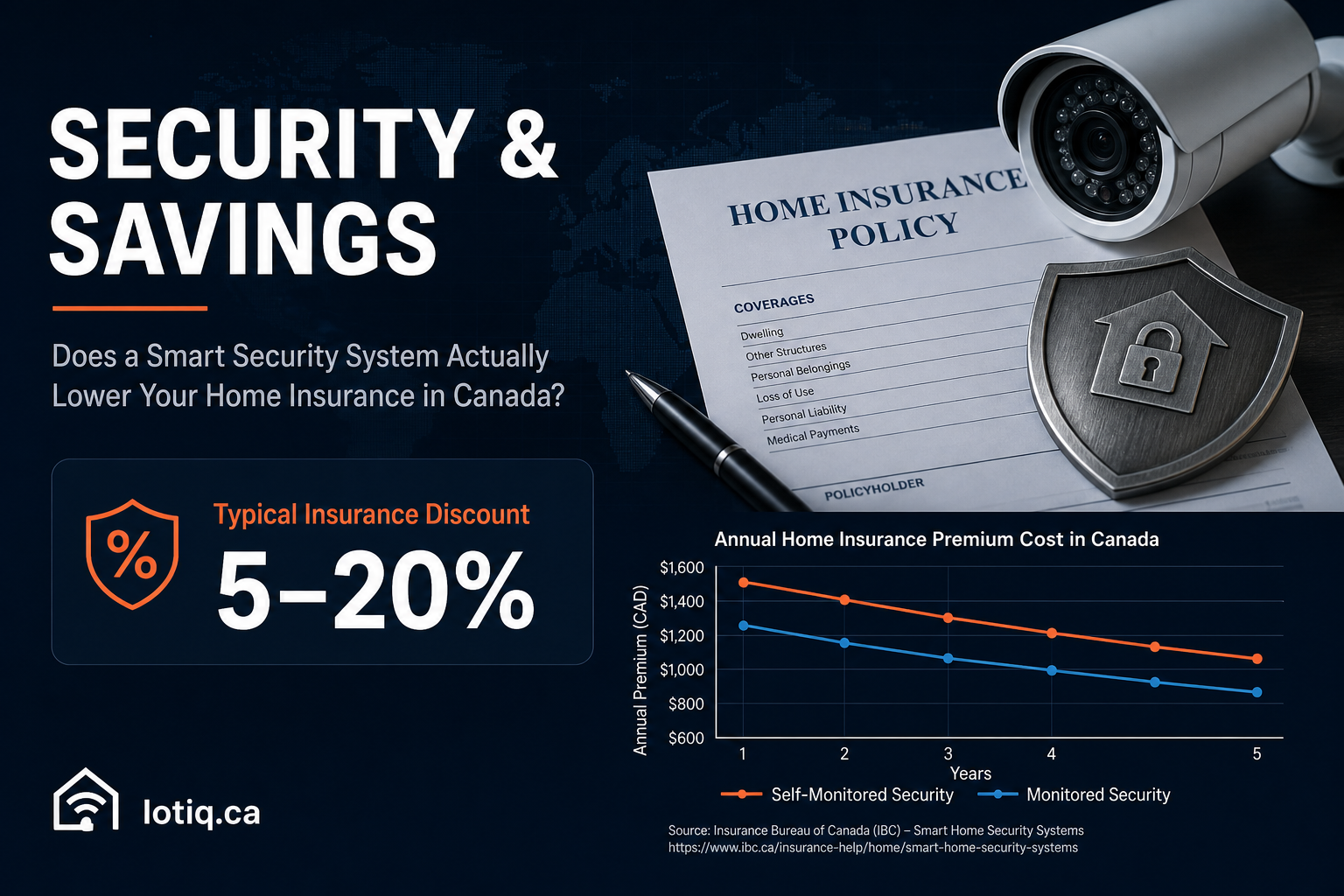
“Smart security systems lower your home insurance” is technically true and also the kind of claim that falls apart the moment an insurer actually asks for documentation. The honest answer has a few more moving parts than most marketing copy admits — and knowing them upfront saves you from assuming a discount that never materializes.
The Number Most Articles Quote, and the Catch Behind It
Canadian insurers commonly offer discounts in the 5–20% range for homes with a security system, and on a typical homeowner’s policy that can genuinely mean a few hundred dollars a year. The catch is in one word most headlines skip: monitored. The size of the discount — and often whether you get one at all — depends heavily on whether your system is professionally monitored by a central station versus self-monitored through an app on your own phone.
This distinction matters more than the device brand or feature list. A self-monitored smart camera and lock setup, where alerts go straight to your phone with no third-party monitoring service watching for you, is a meaningfully different product from an insurer’s perspective than a professionally monitored alarm system with a 24/7 central station that dispatches emergency response. Both improve your actual security. Only one reliably qualifies for the larger insurance credit.
What Insurers Actually Ask For
- A monitoring certificate or letter from your provider, confirming the service address, install date, and exactly what’s being monitored (burglary, fire, water, temperature) — not just “we have a system installed.”
- Exact address matching between the certificate and your policy — a mismatch is a common reason a claimed discount gets rejected.
- Proof the system is actually operational, not simply owned. Some insurers have removed a previously applied discount when a homeowner cancelled a monitoring subscription without telling them.
If you’re evaluating a system specifically for the insurance angle, ask the provider directly whether they issue a monitoring certificate insurers recognize — some do, some don’t, and it’s a fair question to ask before buying rather than after.
What This Means If You’re Buying a Self-Setup System
Most modern smart home security — including self-setup camera, lock, and sensor systems designed for DIY installation — is self-monitored by default: alerts go to your phone, not to a third-party monitoring centre. That’s a legitimate, often preferable choice for a lot of households (no monthly monitoring fee, no third party holding your data), but it’s worth knowing it may not unlock the largest insurance discount tier on its own. Some insurers do offer a smaller “smart home” credit independent of professional monitoring — for smart locks, water sensors, or verified smoke/CO detection specifically — so it’s worth asking your insurer what they credit even without a monitoring contract, rather than assuming the answer is nothing.
What Tends to Qualify, With or Without Monitoring
| Device category | Typically requires professional monitoring for the full discount? |
|---|---|
| Burglar alarm / intrusion detection | Usually yes, for the largest discount tier |
| Smart smoke/CO detection | Sometimes credited independently, especially if it’s in addition to a standard hardwired detector |
| Water leak/flood detection | Often credited independently — water damage is a high-cost claim category insurers specifically want mitigated |
| Smart locks (theft deterrence) | Sometimes a minor independent credit, but rarely the primary discount driver |
The Practical Way to Actually Get the Discount
- Call your insurer before buying anything and ask specifically what they require for a security-system credit — a monitoring certificate, a specific type of monitoring, or particular device categories.
- Confirm whether your chosen system can produce that documentation. If the answer is no, decide whether the discount is worth adding professional monitoring, or whether you’re fine with self-monitoring and no premium credit.
- Notify your insurer if anything changes — cancelling monitoring, moving, or removing devices — since a discount applied under one set of facts can be reversed if those facts change and the insurer finds out at claim time, which is the worst possible moment.
See the full security systems overview for current camera, lock, and sound-detection options, and confirm documentation requirements with your own insurer before assuming a specific discount applies.
Quick Answers
Does a self-monitored (app-only) smart camera system qualify for an insurance discount? Often only a smaller “smart home” credit, if any — the largest discount tiers usually require professional monitoring with documentation, not just phone notifications.
What proof does an insurer typically want? A monitoring certificate or letter confirming the service address, install date, and exactly what’s being monitored — not just confirmation that a system is owned.
