
Aging in Place: How mmWave Sensors Help Seniors Stay Safe Without a Camera

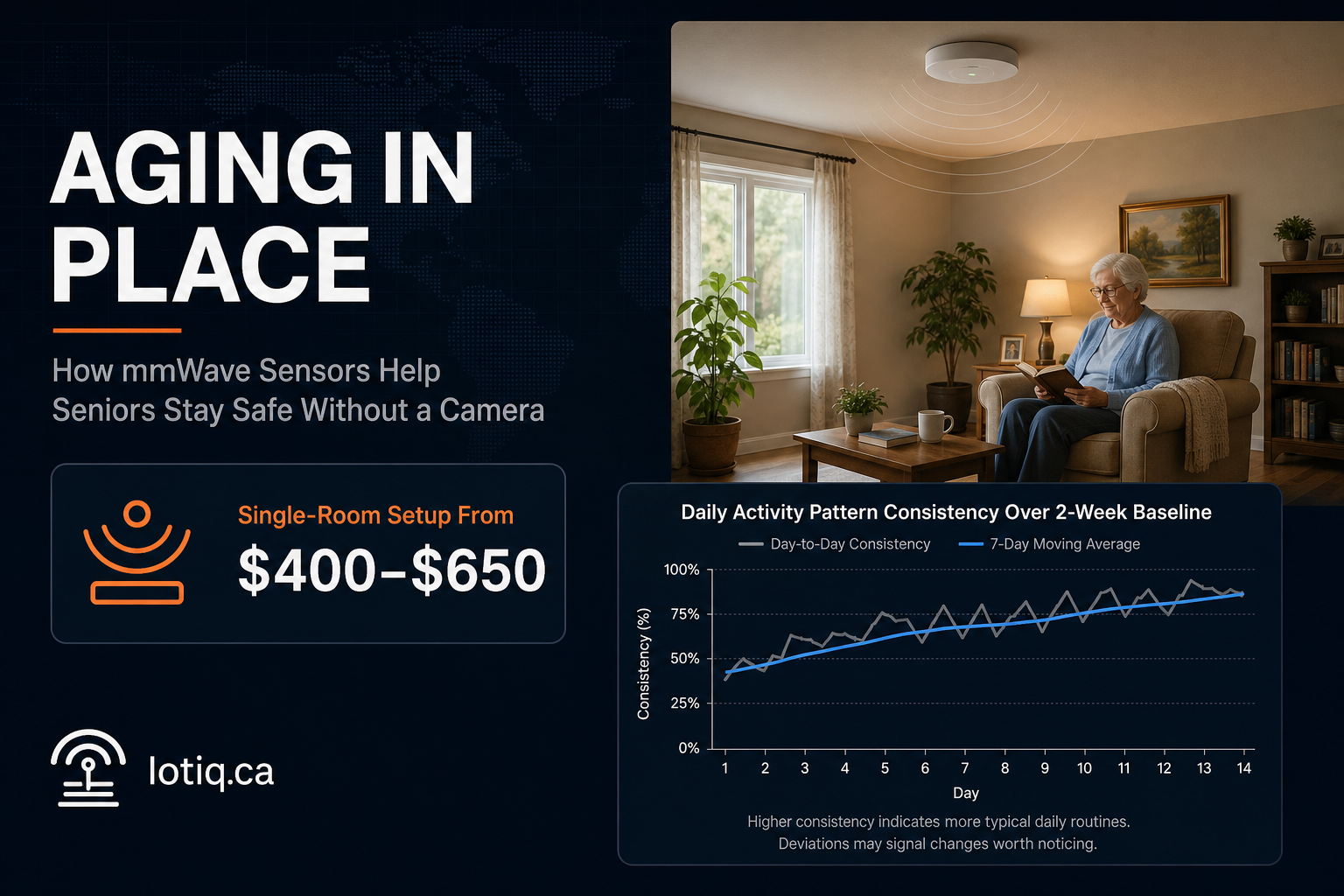
Most conversations about “keeping an aging parent safe” default to two options that don’t sit well with anyone: a wearable pendant they have to remember to put on, or a camera in rooms that should stay private. There’s a third option that’s become viable in the last few years, and it’s worth understanding on its own terms rather than as a compromise between the other two.
The Technology: mmWave Radar, Explained Plainly
Millimetre-wave (mmWave) radar is a sensing technology that detects position, posture, and movement using radio waves — the same general category of technology used in some automotive collision-avoidance systems, adapted for indoor presence sensing. It can tell the difference between someone standing, sitting, and lying on the floor, and it can detect breathing-related micro-movements well enough to distinguish “sleeping” from “not moving because something is wrong.” Critically, it produces no image, audio, or video at any point — there’s nothing to review after the fact, because nothing is being recorded. It only outputs real-time position and movement data.
This matters for a specific reason: a camera in a bedroom or bathroom is where most families draw a hard line, understandably, even when the intent is purely safety-motivated. mmWave sensing was built specifically to solve that tension — full-time monitoring capability, with a data output that’s structurally incapable of being a privacy violation in the way a camera feed would be.
What This Setup Actually Catches
- Falls. A sudden drop to floor level followed by no subsequent movement triggers an immediate alert to designated family contacts — this is the core use case, and response time is measured in seconds, not the minutes it can take for a wearable button to be pressed (assuming it’s being worn and the person is conscious enough to press it).
- Daily pattern deviation. Kitchen visited, bedroom occupied, morning routine on schedule — not because any single data point matters, but because a break from an established pattern (someone who hasn’t left the bedroom by their usual time, for instance) is often the earliest signal that something’s wrong, well before a fall or medical event makes it obvious.
- Extended stillness. A gentle wellness-check notification if activity patterns suggest something’s off, without assuming the worst on a single data point — the system is built around a two-week baseline period specifically so it learns what “normal” looks like for that individual before it starts flagging deviations.
What It Doesn’t Do — Said Plainly
This is not a substitute for professional home care, and treating it as one would be a mistake. It’s a supplement that gives family visibility and fast alerts; it doesn’t provide judgment, medical assessment, or hands-on assistance the way a caregiver does. Families who already have care in place typically keep it — the sensor system fills the gap between scheduled visits, not the visits themselves.
It’s also not a way to monitor someone without their knowledge or consent as an ongoing arrangement. The systems worth using are designed to be visible and understood by the person being monitored, with the ability to activate an “away mode” that suppresses routine activity alerts (while keeping fall detection active) when, for example, they’re visiting family for a few days.
The Consent Conversation Families Avoid — And Shouldn’t
The single biggest predictor of whether a monitoring system actually gets used long-term isn’t the technology — it’s whether the person being monitored was part of the decision, rather than having it decided for them. Framing this as “I want peace of mind, and I don’t want a camera in your bathroom to get it” tends to land very differently than framing it as surveillance. Most people, once they understand there’s no recording and no wearable to manage, are more receptive than families expect.
Single-Room vs Multi-Room: What Actually Changes
| Single-room | Multi-room (bedroom, bathroom, kitchen) | |
|---|---|---|
| Typical cost | $400–$650 | $800–$1,400 |
| Best for | Covering the single highest-risk room — usually the bathroom or bedroom | Full activity-pattern monitoring across the rooms where most of the day actually happens |
| What you get | Fall detection and activity data for that one space | Cross-room pattern data — the “normal morning routine” signal that single-room coverage can’t fully capture |
Most families start with the bathroom, statistically the highest-risk room for falls, and expand from there once they see how the alerts and baseline period actually work in practice.
Getting Started
Setup typically includes a home and routine assessment, discreet sensor placement, and a two-week baseline period before alert thresholds are finalized — see the senior care page for current single-room and multi-room pricing, or the related fall detection page for how the alert technology itself works in more technical detail.
Quick Answers
Does mmWave fall detection record video or audio? No. It produces no image, audio, or video — only real-time position and movement data, which is what allows it to be used in bedrooms and bathrooms without a privacy trade-off.
How long does it take before the system knows what’s “normal” for someone? Typically around two weeks. That baseline period is what lets the system flag genuine deviations rather than normal day-to-day variation.
