
Solar Integration and Energy Dashboards: What AI Rate Optimization Actually Does

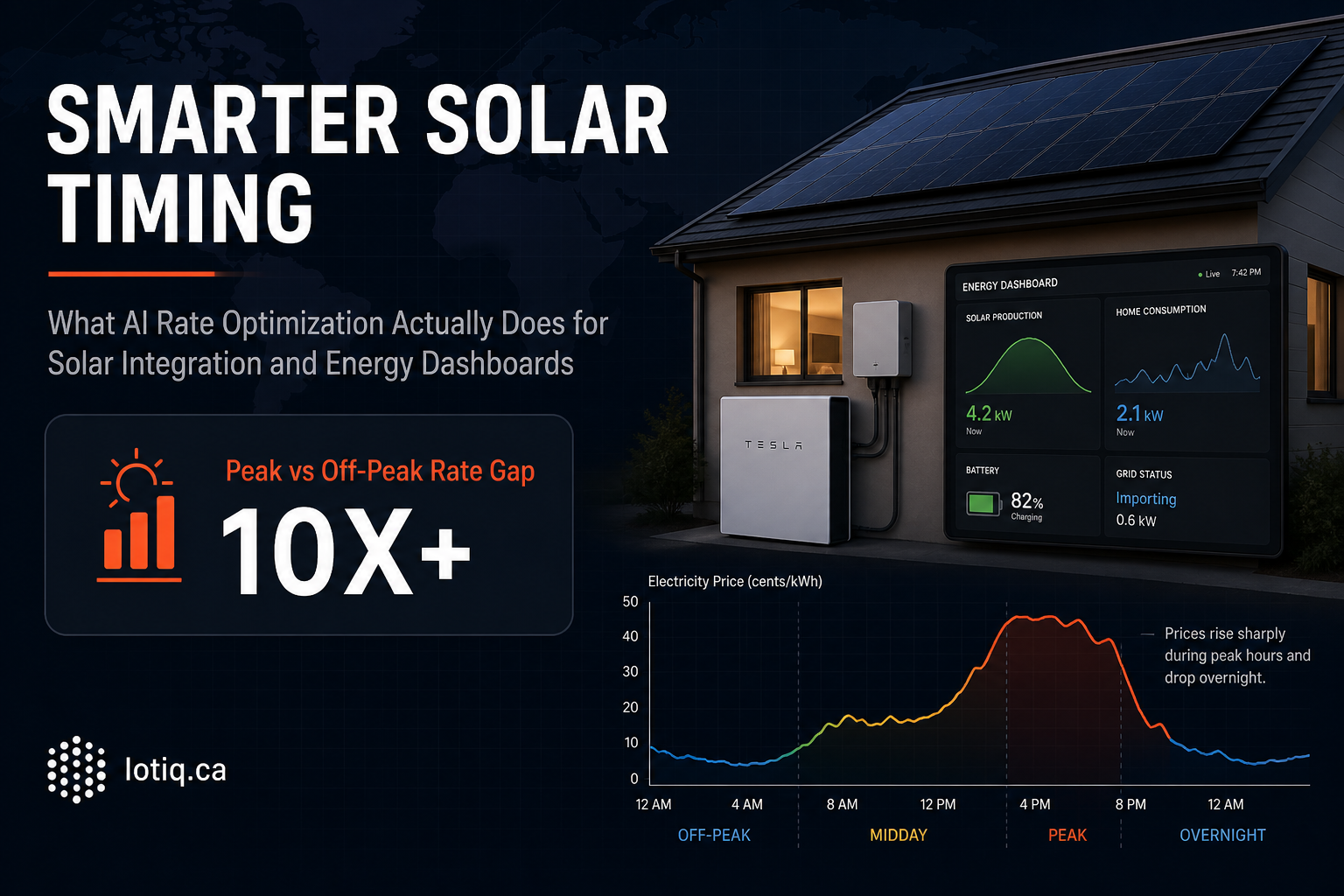
Installing solar panels and battery storage is only half the equation. The other half — deciding, minute by minute, whether to use that energy now, store it, or sell it back to the grid — is where most residential systems leave real money on the table, simply because they don’t have a strategy for timing. Here’s what “AI-optimized” solar management actually means in practice, and why the value of it depends heavily on which province you’re in.
The Problem With Basic Net Metering
A solar system without active management typically does the simplest possible thing: export surplus energy the moment it’s produced, and draw from the grid whenever consumption exceeds production, regardless of what the utility happens to be charging or crediting at that exact hour. That’s not wrong, exactly — it’s just leaving value on the table if your utility’s rates vary by time of day, which is increasingly the case rather than the exception across Canada.
Why Timing Matters So Much — And Why It Depends on Your Province
This is the part worth understanding before assuming a specific dollar benefit: net metering and net billing rules differ significantly by province, and the potential upside from timing your exports and grid draws depends entirely on that structure. Ontario’s time-of-use pricing, for instance, can spread rates from a few cents per kilowatt-hour overnight to well over ten times that during peak periods — a system that exports during peak and charges its battery overnight captures a meaningfully different value than one that treats every hour identically. Other provinces use flat-rate net billing with a single export price regardless of time of day, where the timing advantage shrinks considerably, though charging from the grid during genuinely off-peak hours can still help. The honest takeaway: ask what your specific utility’s export and time-of-use structure actually is before assuming a headline percentage applies to you.
What “AI Management” Actually Does, Mechanically
- Monitors utility rates in real time and times surplus export to coincide with the highest-value period your utility offers, rather than exporting the instant power is generated.
- Charges the battery from the grid during genuinely cheap off-peak hours, where that pricing structure exists, rather than only ever charging from solar.
- Incorporates a weather forecast — if tomorrow is forecast overcast, the system can pre-charge tonight from the grid; if sunny, it can drain the battery further today to make room for tomorrow’s production, rather than wasting potential solar generation to a battery that’s already full.
- Reserves a minimum charge for outage backup, so the optimization strategy doesn’t leave you with an empty battery exactly when a grid outage happens.
None of this requires new panels or a new battery — it’s a management layer that sits on top of solar and battery hardware you already own, reading live rate and weather data and making the charge/discharge/export decision your basic inverter setup wasn’t built to make on its own.
What Gets Connected, Not Installed
Worth being precise about this distinction: this kind of service integrates and optimizes an existing solar and battery system — it doesn’t install solar panels themselves, which is a separate trade requiring a local solar installer. Compatible battery systems typically include Tesla Powerwall, SolarEdge Home Hub, and Enphase IQ Battery, among other major residential systems, with compatibility confirmed during an initial assessment of your specific inverter and battery model.
The Dashboard: Seeing the Decision, Not Just the Bill
A genuinely useful side effect of this kind of integration is visibility: a real-time view of solar production, battery state, grid import/export, and whole-home consumption in one place, rather than four separate apps or waiting for a monthly bill to notice something changed. This same reporting layer typically extends beyond solar to any connected thermostat or circuit-level energy monitor, showing cost per device in dollars rather than just kilowatt-hours — useful for actually identifying which appliance or habit is driving a bill up, rather than guessing.
Is It Worth It for a Smaller System?
Even a modest system — a single battery paired with a 5kW solar array, for instance — can benefit from optimized charge and export timing, though the absolute dollar value scales with system size and your specific utility’s rate structure. The honest way to answer this for your specific situation is a return-on-investment estimate based on your actual system and provincial rate plan, not a generic percentage applied uniformly.
Getting Started
Integration for an existing solar and battery system typically runs $600–$1,500 depending on hardware and complexity, with rate programming and backup reserve configured to your specific utility plan. See the solar integration page and energy dashboard for current pricing and compatible battery systems.
Quick Answers
Does this service install solar panels? No. This kind of integration connects and optimizes an existing solar and battery system; panel installation is a separate trade handled by a local solar installer.
Does timed export management help in every province? The upside depends on your utility’s rate structure. It matters most where time-of-use pricing creates a real gap between peak and off-peak rates; in flat-rate net billing provinces, the timing advantage is smaller.
