
Best Smart Home Devices for Energy Savings in Canada

Electricity rates in Canada vary significantly by province and season, and heating/cooling is consistently the largest chunk of a typical home energy bill. Smart home devices won’t rewrite your utility rate, but the right combination of devices can meaningfully cut waste — the energy you’re paying for but not actually benefiting from — which is a genuinely different problem than simply using less power overall.
Where Smart Devices Actually Move the Needle
Not every smart device saves meaningful energy — a smart bulb you already turn off manually saves little compared to the same bulb with a smart switch. The devices that consistently make a real difference are the ones that target waste specifically: energy used when nobody’s home, phantom power draw from devices left on standby, and heating/cooling running on a fixed schedule instead of responding to whether anyone’s actually there.
Smart Thermostats: The Single Biggest Lever
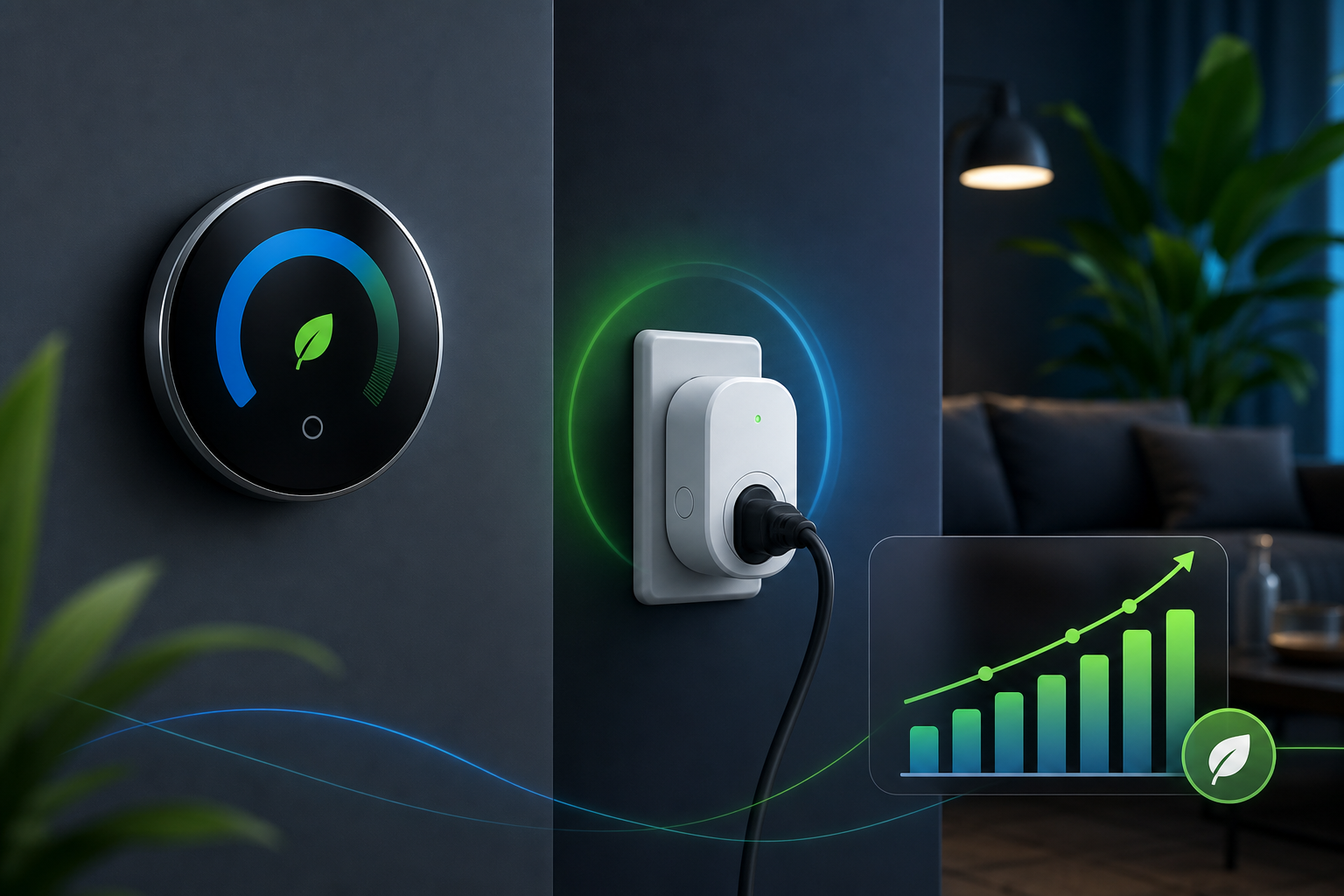
Heating and cooling typically represent the largest controllable portion of a home energy bill in most Canadian climates, which is exactly why a smart thermostat tends to be the highest-impact single device in an energy-focused setup. The core mechanism is simple: a smart thermostat that learns your schedule (or lets you set one precisely) avoids heating or cooling an empty house to the same degree as an occupied one, and geofencing features — using your phone’s location to detect when you’re heading home — can adjust temperature ahead of arrival rather than running on a rigid clock-based schedule that doesn’t account for an unusually early or late day.
Zone-based control is a further refinement worth considering for larger homes: heating or cooling only occupied zones, rather than the whole house uniformly, reduces the amount of conditioned space you’re paying to maintain at any given time.
Energy Monitoring Plugs: Finding the Waste You Can’t See
Standby power — electricity drawn by devices that are technically “off” but still plugged in and drawing a trickle of power — is invisible without measurement. Energy monitoring smart plugs let you see, device by device, which electronics are drawing meaningful standby power (older game consoles, some TVs, chargers left plugged in) versus which ones draw effectively nothing. This diagnostic step matters because intuition about which devices waste power is frequently wrong — the appliance you assumed was the culprit is sometimes negligible, while something you never thought about turns out to be a consistent draw.
Smart Plugs and Switches for Scheduling and Elimination
Once monitoring identifies which devices draw meaningful standby power, smart plugs let you schedule or remotely cut power to them entirely — useful for things like entertainment centers, home office equipment, or seasonal appliances that don’t need to stay powered around the clock. This is a more reliable habit-independent fix than remembering to manually unplug things, since automation doesn’t rely on anyone remembering to do it consistently.
Comparison: Energy-Focused Smart Devices by Impact
| Device Type | What It Targets | Typical Impact Level |
|---|---|---|
| Smart thermostat | Heating/cooling waste from empty-house scheduling | High — usually the largest single opportunity |
| Energy monitoring plugs | Standby/phantom power from specific devices | Medium — high diagnostic value, moderate direct savings |
| Smart plugs (scheduling) | Devices left powered unnecessarily | Medium — depends heavily on which devices are controlled |
| Smart lighting with occupancy/motion control | Lights left on in unoccupied rooms | Low to Medium — smaller share of most home energy bills than heating/cooling |
| HVAC zone/vent controllers | Conditioning unoccupied zones in larger homes | Medium to High in larger or multi-zone homes specifically |
A Realistic Starting Sequence
For a household starting from scratch, a sensible sequence is: start with a smart thermostat since it targets the largest expense category, add a few energy monitoring plugs on your highest-suspicion devices (entertainment centers, home office setups, older appliances) to see real data rather than guessing, then use what that data shows to decide whether scheduled smart plugs or targeted elimination makes sense for specific devices. Lighting automation is worth adding for convenience, but it’s rarely the highest-leverage energy step compared to heating, cooling, and standby power — treat it as a nice addition rather than the centerpiece of an energy-savings setup.
