
What Is a Smart Home? A Practical Guide for Canadian Homeowners

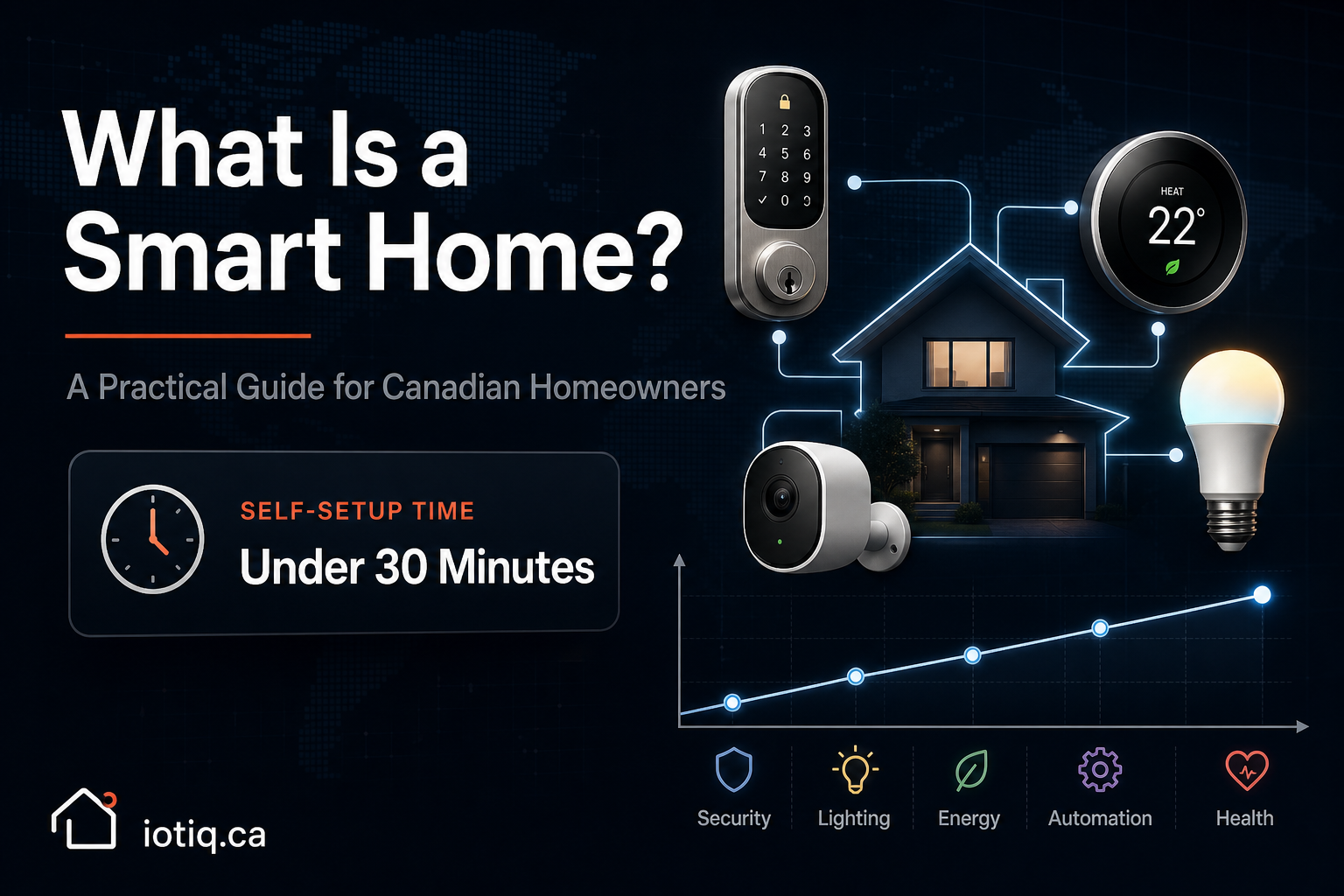
“Smart home” gets used to describe everything from a single voice-controlled light bulb to a fully automated house that adjusts itself before you wake up. If you’re trying to figure out where to start, here’s a practical answer — no marketing fluff, no assumption that you need to spend $20,000 to get started.
What a Smart Home Actually Is
A smart home is a home where individual devices — locks, lights, thermostats, cameras, sensors — are connected to a shared system so they can be controlled remotely, respond to conditions automatically, or work together. The key word is connected. A Wi-Fi light bulb you control from an app is “smart,” but it’s not really a smart home until it’s part of a system: the light turns on when a motion sensor detects you walking into a room, or your thermostat drops automatically when your door lock confirms you’ve left.
In Canada specifically, this usually starts with one of two triggers: a security concern (cameras, locks) or an energy cost concern (thermostats, room sensors) — then expands from there.
The Building Blocks
- Security: cameras, smart locks, doorbells and sensors that detect people, motion or unusual events. See smart home security options.
- Lighting: smart bulbs and switches that respond to motion, schedules or scenes. See smart lighting options.
- Energy: thermostats and room sensors that cut heating and cooling costs — often the fastest payback in a Canadian climate. See energy management options.
- Automation: the layer that connects everything — voice control, routines and scenes that trigger multiple devices from one command. See automation options.
- Health & wellness: air quality monitoring, sleep tracking and fall detection for elderly family members. See health monitoring options.
Do You Need a Technician?
Not anymore, for most of it. The smart home industry used to mean scheduling an installer and paying a labour fee on top of the hardware. Most modern devices — including everything IoTiq ships — are designed for self-setup: unbox, connect to Wi-Fi, and you’re running in under 30 minutes per device. A handful of products (hardwired cameras, some doorbells) may need basic tools, but nothing close to a full installation crew.
What Does It Cost?
A single device (a smart thermostat or one camera) typically starts around $150–$350. A meaningful whole-home security and automation bundle runs $2,000–$6,000 depending on how many rooms and devices you cover. Most people start with one category — usually security or a thermostat — and expand over time rather than buying everything at once. See our full pricing breakdown by category.
Is Data Privacy a Concern?
It should be part of your decision. Many popular smart home brands route your camera footage, voice commands or sensor data through cloud servers — which means a monthly subscription and a third party with access to your home data. IoTiq’s product line is chosen specifically for on-device processing: footage and data stay on a local device in your home, with no subscription required for core functionality.
Getting Started
If you’re new to this, don’t try to automate everything on day one. Pick the category that solves your most immediate problem — security if you’re worried about break-ins or package theft, energy if your heating bill is the pain point — and build from there. Every product we sell is designed to integrate with what you add later, so nothing you buy today becomes obsolete when you expand. Browse all categories or check our FAQ for common questions about setup and compatibility.