
Fall Detection Technology Compared: Wearables vs Camera AI vs mmWave Radar

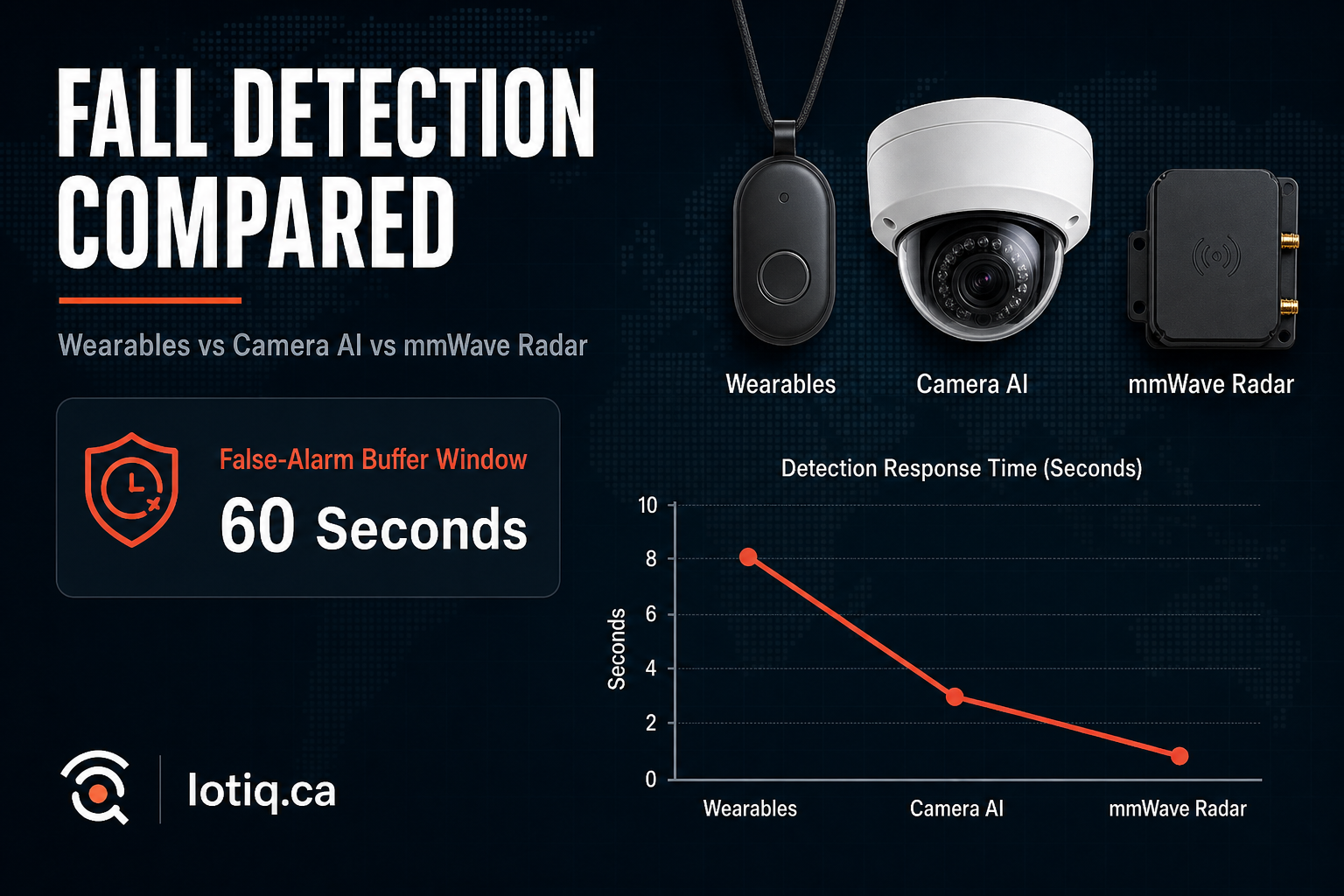
“Fall detection” isn’t one technology — it’s three genuinely different approaches, each with real trade-offs, and most comparison articles skip past that to sell one of them. Here’s an honest technical breakdown of wearable pendants, camera-based AI, and mmWave radar, including where each one actually falls short.
Approach 1: Wearable Pendants and Watches
The oldest and most familiar category — a button-press or accelerometer-based device worn on the wrist or around the neck. Modern versions use motion sensors (accelerometers and gyroscopes) to detect the sudden deceleration pattern of a fall automatically, not just a manually pressed button.
Where it works well: Portable — protection follows the person outside the home, to a mailbox, a yard, a walk around the block, which no fixed sensor can do.
Where it falls short: It only works if it’s being worn, charged, and functioning at the moment of the fall — and compliance is the well-documented weak point of this category. A pendant left on a nightstand overnight, or not put back on after a shower (statistically one of the highest-risk moments for a fall), provides zero protection during exactly the situations it exists for.
Approach 2: Camera-Based AI Detection
Uses computer vision to analyze video feeds for fall-like movement patterns — a person going from vertical to horizontal rapidly, followed by no recovery. Some systems process this on-device, others send footage to cloud servers for analysis.
Where it works well: High detection accuracy in well-lit, unobstructed rooms, and the footage itself can be reviewed after an incident, which the other two approaches don’t offer.
Where it falls short: This is the approach most families reject for bedrooms and bathrooms specifically, and understandably — a continuously recording camera in the most private rooms of a house is a real privacy cost, not a hypothetical one, regardless of how the footage is stored or secured. Camera systems also struggle with occlusion (furniture, blankets, doorways blocking the view) and with rooms that have poor lighting.
Approach 3: mmWave Radar
Millimetre-wave radar detects position, posture, and movement using radio waves rather than visible light or a worn device — a technology adapted from the same general sensing category used in some automotive collision-avoidance systems. It’s passive (nothing to wear, nothing to charge, no button to press) and produces no image, audio, or video output at any point — only real-time position and movement data.
Where it works well: No compliance problem, since there’s no device the person needs to remember; no privacy trade-off, since nothing is recorded; and it works through light materials like clothing and bedding, detecting the person underneath rather than requiring a clear line of sight the way a camera does.
Where it falls short: No footage to review after the fact if you want to understand exactly what happened, and it requires a baseline learning period (typically around two weeks) before activity-pattern alerts are properly calibrated to the individual. It’s also a fixed-location technology — it covers the rooms it’s installed in, not the driveway or the sidewalk outside.
Side-by-Side
| Wearable pendant | Camera AI | mmWave radar | |
|---|---|---|---|
| Requires wearing/charging a device | Yes | No | No |
| Records images/video | No | Yes | No |
| Works outside the home | Yes (portable) | No | No |
| Works through clothing/bedding | N/A | No (needs clear view) | Yes |
| Typical detection response | Immediate (button) or seconds (auto-detect) | Seconds | Seconds, with a configurable confirmation delay to avoid false alerts |
| Biggest real-world weakness | Compliance — must be worn and charged | Privacy in bedrooms/bathrooms; occlusion | Fixed to installed rooms; no outdoor coverage |
The Detail Most Comparisons Skip: False Alerts
Any fall detection system that’s too sensitive becomes background noise the family eventually starts ignoring — which defeats the purpose. A well-tuned mmWave system, for instance, typically uses a short confirmation window (often around 60 seconds) after detecting a floor-level position before sending an alert, specifically so a trip-and-recover or a moment on the floor doing yoga or gardening doesn’t trigger a false alarm. Whichever technology you’re evaluating, ask specifically how false positives are handled — “how sensitive is it” is the wrong question; “how does it avoid crying wolf” is the right one.
Which One Actually Makes Sense
For most households evaluating this for an aging parent living independently at home, the practical answer is a combination: mmWave radar for the home itself (no compliance burden, no privacy cost, works around the clock without anyone remembering anything), and a portable option only if outdoor mobility away from the house is a specific, real concern for that individual. Camera-based systems tend to make sense in shared or common spaces — a hallway, a living room — rather than bedrooms and bathrooms, where the privacy cost is highest and the coverage gap from a radar system is smallest anyway.
See the fall detection page for current mmWave sensor pricing and room-by-room configuration.
Quick Answers
Which fall detection technology works outside the home? Only wearable pendants and watches — camera-based and mmWave systems are fixed to the rooms they’re installed in.
Why do camera-based systems struggle in bedrooms specifically? Mainly privacy — most families reject continuous recording in bedrooms and bathrooms regardless of how secure the footage storage is, plus cameras need a clear line of sight that blankets and furniture can block.
